

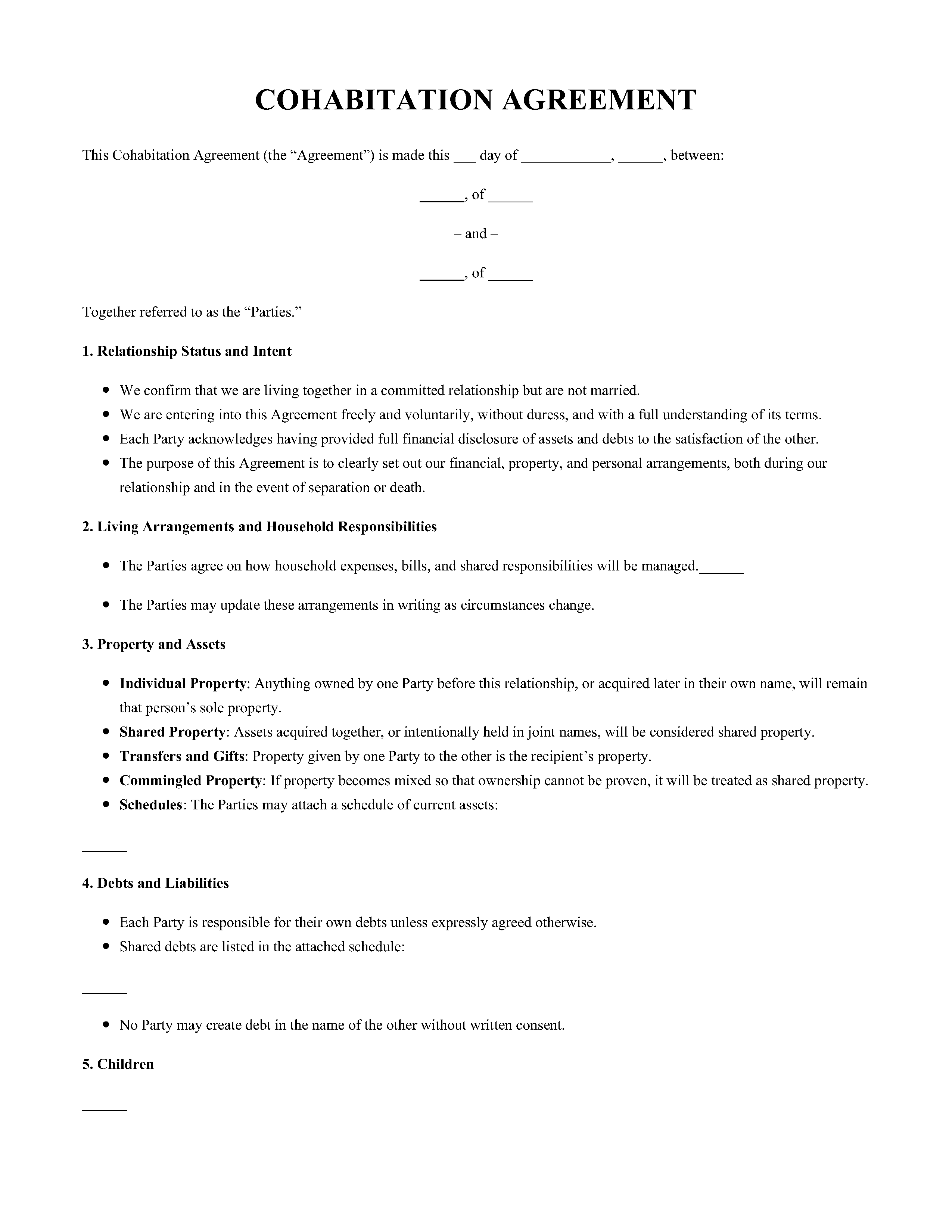
Free Cohabitation Agreement Template
A formal legal contract for unmarried partners living together. This template covers property rights, financial contributions, and the division of assets. It is designed to provide legal certainty and peace of mind for couples who wish to define their financial arrangements outside of traditional marriage laws.
 PDF
PDF Word
Word Preview
 NOTARYPRO GUARANTEE
How it Works
Fill out our simple
online form with your
information.
Review and approve
the generated
document.
Once your document
is ready, you can
Notarise!
Meet with a notary public and draft your document
Meet a licensed professional online to draft your document. Get it completed in minutes.
 $99.95
$249.00
• Save: $149.05 (60%)
$99.95
$249.00
• Save: $149.05 (60%)

Featured NotaryPro Expert in Toronto
 See how our experts help you draft
Contents
-
What is a Cohabitation Agreement?

-
Why is a Cohabitation Agreement important in Ontario?
-
When Do I Need a Cohabitation Agreement in Ontario?
-
What Details Should an Ontario Cohabitation Agreement Contain?
-
Is an Ontario Cohabitation Agreement Legally Binding?
-
Does a Cohabitation Agreement Need to Be Commissioned in Ontario?
-
Draft an Ontario Cohabitation Agreement Today
-
Frequently Asked Questions
What is a Cohabitation Agreement?
A Cohabitation Agreement is a legal contract that outlines the rights and responsibilities of a couple who live together but are not married. Since cohabiting spouses don’t receive the same protection as married couples in Ontario, cohabiting partners often use this Agreement for protection instead. Cohabiting partners can also use it to protect themselves in the event of a separation.
A Cohabitation Agreement protects each party’s financial interests, details property rights, and details future support commitments. More specifically, it can establish expectations about:
- Household expenses and finances
- Debt responsibilities
- Asset and property ownership
- Spousal or child support if the relationship ends
In Canada, a Cohabitation Agreement is also known as:
- Common-Law Partner Agreement
- Living Together Agreement
- Adult Interdependent Partner Agreement (in Alberta only)
Do you have Questions about your Cohabitation Agreement Document ?
 Create Cohabitation Agreement Now
Why is a Cohabitation Agreement important in Ontario?
In Ontario, an unmarried couple may be considered common-law after 3 years of cohabitation or immediately after having a child together. Many couples don’t expect that this status can trigger significant legal and financial obligations.
These can include spousal support claims, property disputes, debt repayment responsibility, and estate support claims. By outlining expectations early, a Cohabitation Agreement reduces uncertainty, limits financial vulnerability, and helps partners avoid costly legal disputes. It also keeps control with them, rather than allowing the courts to make personal decisions for them.
Learn to manage legal obligations related to common-law status by reading our blog, Common-Law Ontario: Minimize Financial Risks with a Cohabitation Agreement.
When Do I Need a Cohabitation Agreement in Ontario?
In Ontario, a couple might use a Cohabitation Agreement for various situations. They might create one if they plan to purchase a common-law home or remain in a long-term, unmarried relationship. Another reason a couple may want to draft this Agreement is that one or both partners have a complicated financial history.
A Cohabitation Agreement can be used to:
- Clarify what happens if one spouse contributes to the other’s property
- Outline how property will be divided
- State who will move out of the home
- Clarify how the Agreement will be changed due to major life changes
- Detail how assets will be divided when partners purchase them together
- Determine how each person’s debts will be managed
- Outline household expenses and shared finances
- Detail spousal support payment details
- Outline repayment terms for shared debts
What Details Should an Ontario Cohabitation Agreement Contain?
A Cohabitation Agreement is a highly personal legal contract that varies from couple to couple. There are no regulations around which terms you must agree on in your Agreement. That said, it’s best to be as clear and detailed as you can.
Fundamentally, a Cohabitation Agreement should have your and your partner’s personal information. This includes your full legal names, respective occupations, address, and the date you started cohabiting. Further, you can choose to include the following details in your Agreement:
The Division of Tasks and Expenses
You can outline how you and your partner will be dividing household expenses during cohabitation. For example, some expenses can be paid from a joint account, while others are split between you. Couples often split expenses by income, type, and percentage.
You can also outline important non-monetary rights and obligations, like which tasks each of you is responsible for and which are shared.
Address Personal Assets
If you own assets, you can list which ones you want to keep to yourself in your Cohabitation Agreement. This ensures that your partner doesn’t have access to your assets should the relationship dissolve.
You can also outline which assets you’d like to share with your partner in your Agreement. These can include vehicles, property, jewellery, and more. You can divide assets equally or by each partner’s financial situation or contribution. Another option is for one spouse to pay out the value of an asset to the other, so the other spouse has total ownership.
Division and Ownership of Property
You can state who owns what property and how you will divide ownership in the case of a separation. In addition to real estate, “property” can actually include jewelry, bank accounts, pensions, and business assets.
You can document your intention to keep property and assets separate with a Cohabitation Agreement. This reduces the risk of future claims arising from constructive trust, unjust enrichment, or joint family venture. Doing this gives you greater control over your property and helps protect your financial interests. Without clearly stated property terms, a court may decide these issues after a dispute arises.
It’s also best to coordinate your Cohabitation Agreement with a Will when addressing inheritances or estate planning. Although a Cohabitation Agreement can document intentions and limit specific claims, only a Will or Trust can determine how your estate is distributed.
Debt Details
In addition to assets, it’s important to include personal and shared debts in your Agreement. If you or your partner had acquired debts before cohabiting, you can state who will be responsible for repaying them. Also, you can indicate which of your debts are shared and how you will divide them during repayment.
Child Support and Education
In Ontario, if you have dependent children with your partner or from a prior relationship, you can include them in your Agreement. You can detail how you will handle children’s education, child support obligations, and children’s moral training.
This includes how you’ll raise children, the religion they’ll practice, and the educational path they’ll pursue. Adding such information ensures you and your partner are on the same page about critical matters concerning children.
The Agreement cannot address parenting time (formerly known as access) or decision-making responsibility for children (formerly known as custody). If you need to, you can include these details in a Separation Agreement. The courts will consider the best interests of the children and decide on child custody matters.
Child support terms must comply with Ontario’s Child Support Guidelines and are subject to court review in the best interests of the child. A Cohabitation Agreement cannot override a child’s right to support. It also can’t stop a court from stepping in to protect a child’s best interests, or take away legal rights if doing so would be unfair or illegal.
Spousal Support Obligations
In Ontario, spousal support details can be included in your Cohabitation Agreement and enforced. Failing to include this information can put either partner at a disadvantage if the relationship ends. You can also include spousal support limitations or releases based on changing circumstances, such as salary changes.
Is an Ontario Cohabitation Agreement Legally Binding?
So long as your Cohabitation Agreement meets the criteria for a valid domestic contract under Ontario Law, it’s legally binding. If anyone plans to challenge your Cohabitation Agreement, they must prove that it’s invalid in court.
Like any contract, a Cohabitation Agreement must contain certain elements to be legally enforceable. In addition, a Cohabitation Agreement needs to be:
Made in writing;
- Dated and signed by each partner, before two witnesses
- Dated and signed by each witness;
- Signed by parties and witnesses 18 or older;
- Clear in identifying both partners and the nature of their rights and obligations;
- Signed once both parties have disclosed their assets, liabilities and circumstances.
- The absence of full financial disclosure may render the Agreement invalid.
Does a Cohabitation Agreement Need to Be Commissioned in Ontario?
Your agreement must be witnessed by two witnesses over the age of 18. Ontario law doesn’t require your witnesses to be authorized officials, like lawyers or paralegals. However, we recommend having your Agreement commissioned by a notary public.
Commissioning offers strong evidence to establish your Cohabitation Agreement’s validity and authenticity. This process reduces the likelihood that your Agreement’s legitimacy will be questioned in future disputes, should you need to take legal action.
Additionally, commissioning is advisable if you plan to use your Cohabitation Agreement internationally. Commissioning may be helpful in jurisdictions outside Ontario or Canada, but acceptance depends on the receiving authority’s requirements.
You can meet with a notary online and have your Cohabitation Agreement commissioned in under 7 minutes. Get extra peace of mind in less time than a coffee break — from the comfort of your home or office.
Draft an Ontario Cohabitation Agreement Today
Drafting a Cohabitation Agreement is simpler than ever before with our free Ontario Cohabitation Agreement template. Simply fill in the relevant sections and have a perfectly formatted Cohabitation Agreement sent to your email.
Once both parties have signed the agreement, book an online notary appointment to have it commissioned for added credibility.
Frequently Asked Questions
Yes, you can create a Cohabitation Agreement if you and your partner are already living together. You may create this Agreement before or after you begin cohabitation.
It’s best to create a Cohabitation Agreement before cohabitation, or right at the start. It’s often easier to come to an agreement at this stage than at any other stage in your relationship. Later, certain issues or expectations might surface that make creating the Agreement more difficult.
Yes, if you and your partner drafted a Cohabitation Agreement yourselves, it is enforceable. If your Agreement meets the requirements for a valid domestic contract under Ontario Law, it’s legally binding. Additionally, it must meet the specific criteria required for a Cohabitation Agreement to be enforceable.
You can include details regarding finances, support, property, and child-rearing practices in your Agreement. However, you should not include information regarding parenting time or decision-making responsibility.
Your Cohabitation Agreement can become a marriage contract if you and your partner decide to marry. Alternatively, you can choose to terminate your Cohabitation Agreement upon marriage and create a Marriage Contract.
If your Cohabitation Agreement meets the requirements for a valid domestic contract under Ontario Law, it’ll be enforceable.
Each partner is encouraged to obtain independent legal advice before signing a Cohabitation Agreement. This is especially true for complex or high-conflict cases. Courts may set aside an Agreement if one party failed to understand its terms or was pressured to sign.
A Cohabitation Agreement can be amended or terminated via written agreement signed by both partners and witnessed.
It’s best to formally document all changes to avoid disputes. It’s a good idea to review and update your Cohabitation Agreement after major life changes. These can include having children, purchasing a home, or significant income changes.
 for instant explanation
NOTARYPRO GUARANTEE
 1537+ Downloads