

General Affidavit
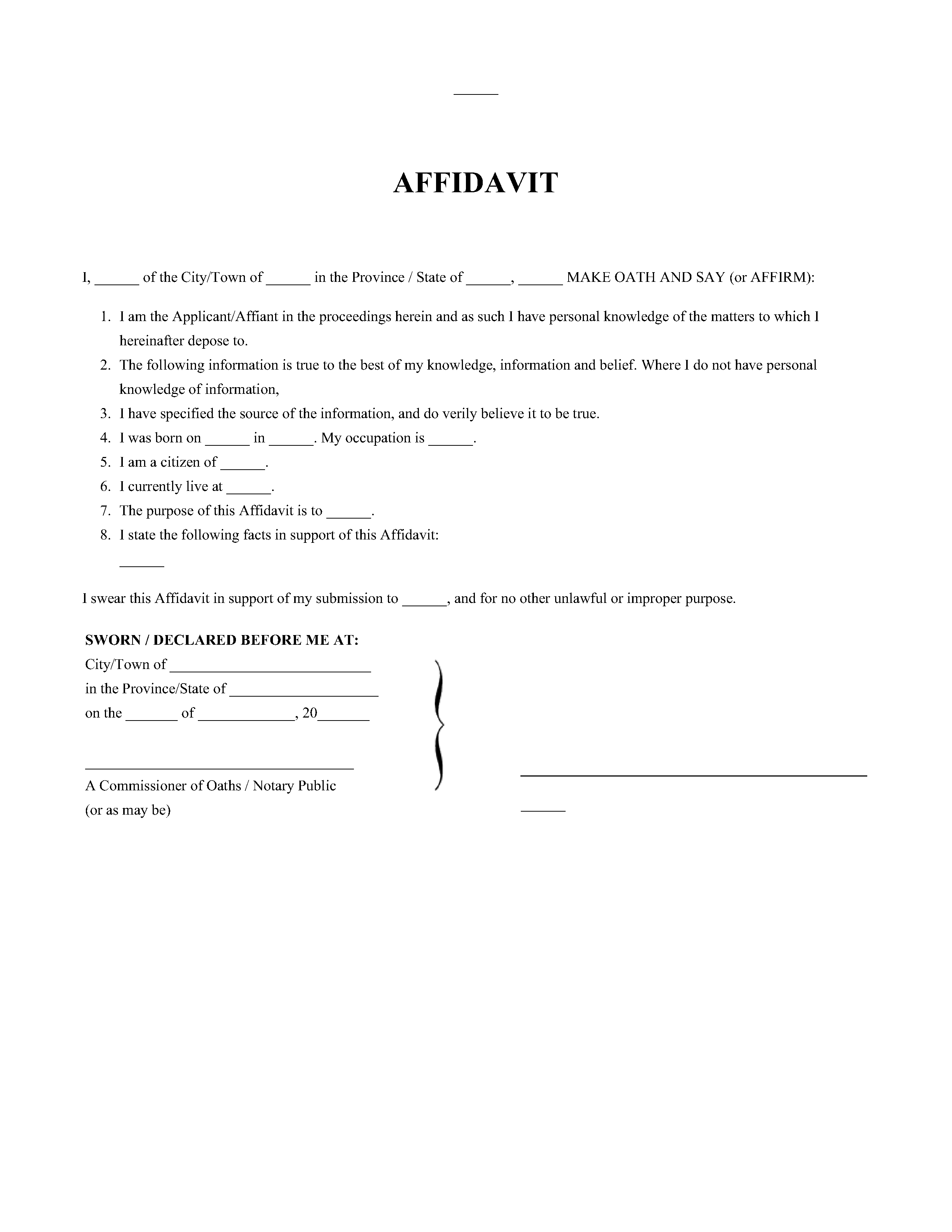
A multipurpose legal document used to swear or affirm facts under oath. This template provides the essential framework for a valid Affidavit, including the statement of facts and the section required for commissioning.
 PDF
PDF Word
Word NOTARYPRO GUARANTEE
 Preview
Meet with a notary public and draft your document
Meet a licensed professional online to draft your document. Get it completed in minutes.
 $99.95
$249.00
• Save: $149.05 (60%)
$99.95
$249.00
• Save: $149.05 (60%)

Featured NotaryPro Expert in Toronto
 See how our experts help you draft
 NOTARYPRO GUARANTEE
How it Works
Fill out our simple
online form with your
information.
Review and approve
the generated
document.
Once your document
is ready, you can
Notarise!
Meet with a notary public and draft your document
Meet a licensed professional online to draft your document. Get it completed in minutes.
$99.95
$249.00
• Save: $149.05 (60%)
Featured NotaryPro Expert in Toronto
See how our experts help you draft
Contents
-
What is an Affidavit in Canada?

-
Who Can Swear an Affidavit?
-
How Do I Create an Affidavit?
-
Attaching Evidence as an Exhibit to Your Affidavit
-
When Do You Need an Affidavit in Canada?
-
Affidavit vs. Statutory Declaration in Canada
-
How to Properly Sign an Affidavit
What is an Affidavit in Canada?
An Affidavit is a legal document that serves as evidence to support an individual''s claims. It contains a written statement of facts and circumstances related to a specific matter. These facts must be based on personal knowledge, not opinions.
To make it valid, an authorized official, like a notary or commissioner of oaths, must witness and sign your Affidavit with you.
The contents of an Affidavit must be sworn or affirmed under oath by the person signing the Affidavit. This person is known as the “affiant” or “deponent”. Swearing or affirming your Affidavit means you’re officially stating that the facts in it are true to the best of your knowledge.
Affidavits are often used as evidence in court cases or to support or oppose motions and applications. Providing untrue or inaccurate information in an Affidavit can be considered perjury, which is a criminal offence in Canada.
In Canada, an Affidavit can also be known as a:
- Sworn statement
- Sworn Affidavit
- Statement under oath
If your Affidavit is used in court, it’s typically filed with the court and shared with the other parties. Requirements vary by province, territory, and type of proceeding.
Do you have Questions about your Affidavit Document ?
 Create Affidavit Now
Who Can Swear an Affidavit?
Generally, a person who is 14 or older, mentally capable of understanding the oath or affirmation, and able to communicate the truth may swear an Affidavit. Anyone swearing an Affidavit must understand that they are making a sworn statement of truth.
How Do I Create an Affidavit?
An Affidavit should include all the necessary details required to support your claim or statement of facts.
If a judge will be reviewing your Affidavit, include the relevant details they would need to make a decision about the matter. If applicable, it should also specify whether you’re writing it on behalf of the claimant or the defendant.
All the information in an Affidavit must be true, accurate, and complete to the best of an affiant’s knowledge. Telling the truth is critical, as knowingly providing false information in an Affidavit is considered perjury, which is an indictable offence. Beyond perjury, if your Affidavit is found to contain false information, it can hurt your chances in court.
Below are some of the key elements that should be included in your Affidavit:
- Affiant''s Statement: This includes the affiant’s full name and location. They must identify as the person making the Affidavit, e.g., “I, Joe Smith, make Oath and Say”.
- Knowledge Statement: This is the first paragraph of the Affidavit; it explains how the affiant acquired personal knowledge of the facts they describe.
- Body of the Affidavit: An outline of evidence and explanation of certain facts or claims.
- Recipient of Your Affidavit: States where the Affidavit is going (e.g., court, government organization, etc.) and that it wasn’t made for unlawful purposes.
- The Jurat: This is the section that the notary or commissioner signs, stamps, and dates the Affidavit. It’s used to confirm that the affiant swore or affirmed the Affidavit before them, and the affiant also signs this portion.
For more tips on how to structure and word your Affidavit, see our blog, How to Write an Affidavit.
Attaching Evidence as an Exhibit to Your Affidavit
You can attach relevant evidence to your Affidavit if it supports the facts you’ve stated. Evidence attached to an Affidavit is called an exhibit; this evidence can include a document, photograph, or record.
If you’ve stated in your Affidavit that you earn an annual salary of $65,000, you can attach a recent tax slip to your Affidavit. Each piece of evidence is labelled as an Exhibit and identified by letter or number (for example, Exhibit “A”, Exhibit “B”).
In the Affidavit, you''d write, “Attached to my Affidavit as Exhibit ‘A’ is a true copy of my 2025 T4 tax slip”. Each exhibit must be clearly labelled so decision-makers understand what the document is and how it relates to your Affidavit.
When the Affidavit is commissioned, the notary or commissioner marks each exhibit, usually by:
- Signing or initialling each exhibit
- Adding a brief exhibit declaration or stamp confirming it’s attached to the Affidavit
The exhibit is usually stapled or securely fastened to the Affidavit and becomes part of the sworn document. Once commissioned, you shouldn’t remove or alter any exhibits — doing so may raise tampering concerns.
Clear, relevant exhibits can strengthen your Affidavit by providing concrete support for your claims. This can make it easier for decision-makers to rely on the information you’ve provided.
When Do You Need an Affidavit in Canada?
In Canada, Affidavits are typically required when an individual must provide evidence of a claim or to support facts in legal proceedings. Courts can require you to submit an Affidavit as evidence and may accept one instead of in-person testimony.
At a high level, you might need to create an Affidavit for the following purposes:
- Civil litigation;
- Family law;
- Criminal law;
- Commercial law;
- Business law;
- Property law; and
- Canadian immigration procedures.
More specifically, you may need an Affidavit in the situations outlined below:
- Contract Breach Disputes: To outline the terms and conditions of a contract, and how it was allegedly breached (e.g., a landlord-tenant dispute).
- Property Disputes: To help prove ownership of property. In land disputes, an affiant can present evidence to support the locations of boundaries and property lines.
- Estate administration: To outline debts, assets, and a distribution plan.
- Divorce Cases: To present facts relevant to their case, such as debt, assets, and income details.
- Immigration Applications: To support various immigration applications, such as spousal sponsorship or permanent residency.
- Criminal Proceedings: To outline facts in a criminal case, support bail, or justify a search warrant.
- Child Access Disputes: To explain a parent’s involvement in their child’s life and their ability to provide for the child.
- Administrative Law: To present relevant facts to appeal a decision made by the Canada Revenue Agency or the Canadian Government.
- Will Contestations: To detail the circumstances surrounding the creation of a person’s Will
- Personal Injury Claims: To detail the events leading up to an accident.
- Educational Loans: To prove a certain status (e.g., relationship status) when applying for post-secondary educational loans.
- Proof of Vehicle Ownership: To prove that you own a vehicle or other asset when you’ve lost its original Bill of Sale.
- Real Estate Transactions: To affirm property ownership and the absence of legal claims, disputes, or liens against the property.
- Visa applications: Sometimes an employer or sponsor drafts an Affidavit to confirm employment or the purpose of a visit.
Affidavit vs. Statutory Declaration in Canada
Affidavits and Statutory Declarations are written statements of fact that present information with numbered sentences and paragraphs. Both can be used as evidence and must be affirmed to be true before an authorized official, like a notary public.
Further, both documents must be witnessed, signed, and stamped by an authorized official. Lastly, Affidavits and Statutory Declarations are subject to the rules of evidence in provincial and federal Canadian courts. This means that providing false information in either document can be considered a criminal offence.
However, there are some differences between an Affidavit and a Statutory Declaration. A Statutory Declaration is usually used outside of court, while an Affidavit is typically used for legal proceedings. Another difference is that a person making a Statutory Declaration is known as a declarant; they declare facts to be true. A person who files an Affidavit is called an affiant, and they swear or affirm facts to be true.
How to Properly Sign an Affidavit
An Affidavit must be commissioned by an authorized official, like a notary public or commissioner of oaths, to be valid.
During commissioning, a witness swears or affirms that the contents of their Affidavit are true before the official. They’ll sign the Affidavit while an official witnesses their signature, and the official will sign it as well. See our blog to learn more about the process of commissioning.
Swearing involves taking an oath on a religious text, while affirming is a solemn promise without religious content. Courts treat both methods exactly the same, so you can choose the one that works best for you.
You can meet with a notary public online to have your Affidavit commissioned in 7 minutes, from anywhere.
No, you don’t need a lawyer to prepare an Affidavit. You can draft one yourself; see our guide on how to properly write an Affidavit for additional guidance.
Yes. In many provinces and territories, Affidavits can be commissioned online over a secure video appointment with a notary or commissioner, provided local rules are followed. It's best to check whether digital commissioning is permitted in your area.
If the Affidavit hasn't been commissioned yet, you can correct it. However, once it’s commissioned, you should not alter it. If it needs updates after you've commissioned it, you may need to prepare a new Affidavit.
An Affidavit doesn't typically expire, but it can become outdated if circumstances change. Some courts or organizations require recent Affidavits, so it's best to check their requirements.
If it’s filed in court, the court typically will keep the original. For administrative matters, the recipient organization may keep a copy or the original. You should always retain a copy for your records.
 for instant explanation
NOTARYPRO GUARANTEE

 2849+ Downloads