

Free Power of Attorney for Personal Care Template
 PDF
PDF Word
Word NOTARYPRO GUARANTEE
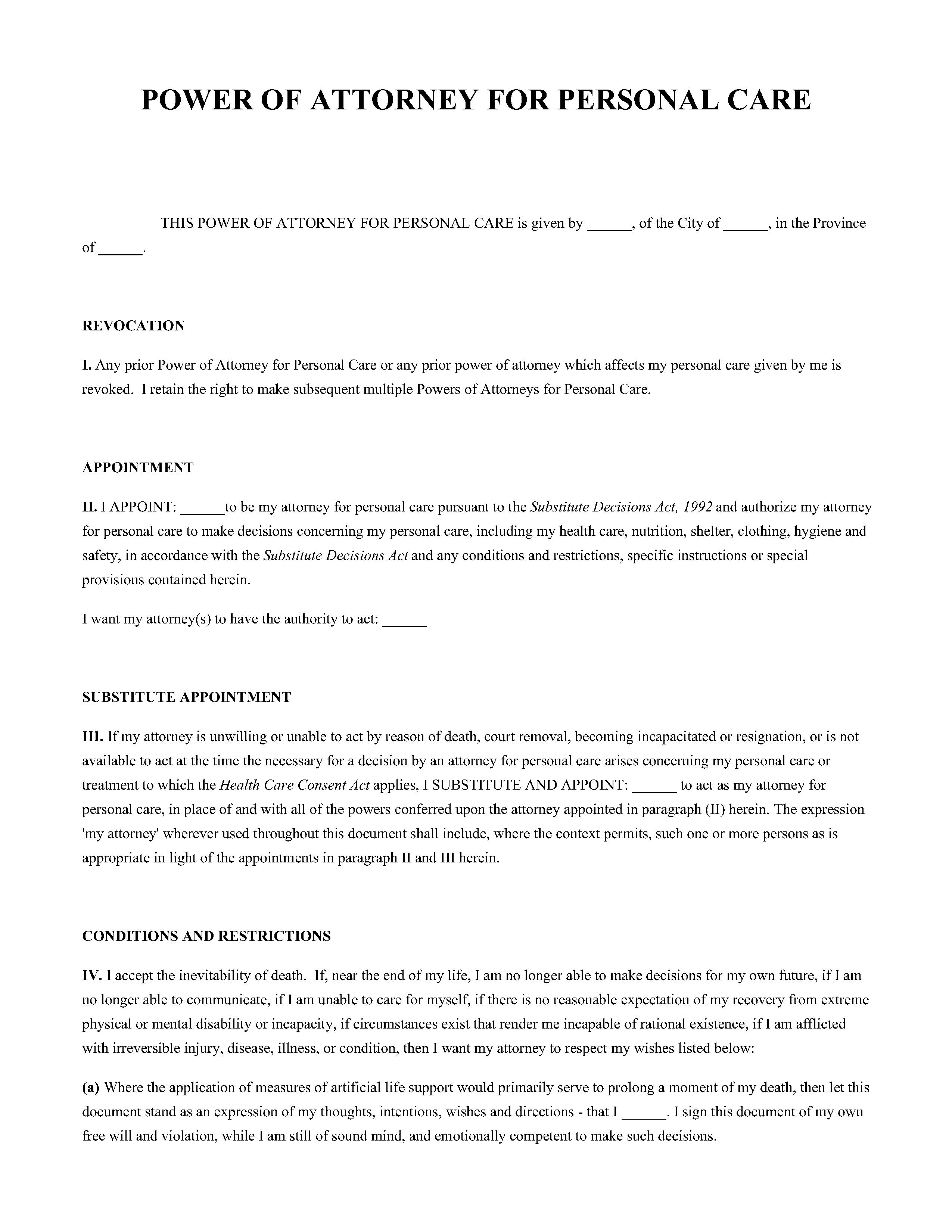
 Preview
Meet with a notary public and draft your document
Meet a licensed professional online to draft your document. Get it completed in minutes.
 $99.95
$249.00
• Save: $149.05 (60%)
$99.95
$249.00
• Save: $149.05 (60%)

Featured NotaryPro Expert in Toronto
 See how our experts help you draft
 NOTARYPRO GUARANTEE
How it Works
Fill out our simple
online form with your
information.
Review and approve
the generated
document.
Once your document
is ready, you can
Notarise!
Meet with a notary public and draft your document
Meet a licensed professional online to draft your document. Get it completed in minutes.
$99.95
$249.00
• Save: $149.05 (60%)
Featured NotaryPro Expert in Toronto
See how our experts help you draft
Contents
-
What is a Power of Attorney for Personal Care?

-
The Purpose of a Power of Attorney for Personal Care
-
Who Can Make a Valid Power of Attorney for Personal Care?
-
What Decisions Can an Attorney for Personal Care Make?
-
What Responsibilities Does a Personal Care Attorney Have?
-
Choosing a Personal Care Attorney
-
Can You Have More Than One Attorney for Personal Care?
-
Naming a Substitute Attorney in Your Power of Attorney for Personal Care
-
When is a Power of Attorney for Personal Care Used in Ontario?
-
Information in Your Power of Attorney for Personal Care
-
When Does a Power of Attorney for Personal Care Take Effect in Ontario?
-
Who Can Witness a Power of Attorney for Personal Care?
-
Have Your Power of Attorney for Personal Care Witnessed Online
-
Estate documents like Powers of Attorney must be signed on physical paper, with wet ink. NotaryPro has helped thousands of clients sign estate documents online using this method. Here’s how our Virtual Witnessing Service works:
-
Frequently Asked Questions
What is a Power of Attorney for Personal Care?
A Power of Attorney for Personal Care is a legal document that allows someone to make decisions about your personal care. This person, known as your attorney, does not need to be a lawyer. Your attorney will make personal care decisions for you only if you cannot make them yourself.
A POA for Property differs from a POA for Personal Care because it deals solely with your financial decisions. You can choose a different person to act as your attorney for personal care and property. Use our free Continuing Power of Attorney for Property template if you need to draft one.
Do you have Questions about your Power of Attorney for Personal Care Document ?
 Create Power of Attorney for Personal Care Now
The Purpose of a Power of Attorney for Personal Care
Completing a POAPC ensures you control who makes personal care decisions for you if you become mentally incapacitated. Without a POAPC, a family member may lack the authority to make all necessary personal care decisions for you.
When no POAPC exists, a substitute decision-maker will be appointed based on the Health Care Consent Act (HCCA) hierarchy. To learn more, refer to the Guide to Substitute Decision-Making Brochure.
Who Can Make a Valid Power of Attorney for Personal Care?
You must be at least 16 years old and mentally capable of creating a valid POAPC. You need the mental capacity to understand whether the person you appoint genuinely cares about your well-being. You must also understand that this person may need to make personal care decisions for you.
What Decisions Can an Attorney for Personal Care Make?
Your attorney will make personal care decisions for you if you become mentally incapable of making them yourself. Personal care decisions include aspects such as your living situation and health care.
Health care decisions can include, but aren’t limited to:
- agreeing to or refusing medical treatments
- choosing a long-term care home,
- coordinating assistance services in care facilities
- decisions regarding housing, meals, clothing, hygiene, and safety
What Responsibilities Does a Personal Care Attorney Have?
Attorneys for Personal Care handle significant decisions regarding your health and personal care. Their responsibilities include:
- Making treatment decisions based on your capable wishes or your best interests if your wishes are unknown.
- Consulting with family and friends involved in your care.
- Supporting your independence.
- Acting diligently and in good faith.
- Choosing the least restrictive and intrusive options.
- Encouraging regular contact between you and loved ones.
- Allowing you to participate in decisions as much as possible.
Choosing a Personal Care Attorney
Choose your personal care attorney thoughtfully, as they will make crucial decisions affecting your life. Many people select a trusted family member, friend, or spouse.
Your attorney must meet these requirements:
- Be at least 16 years old.
- Be someone you trust deeply to make critical decisions.
- Be willing to take on the responsibilities of an attorney.
Certain people cannot serve as your attorney, including anyone who provides your care for compensation (unless they are your spouse or relative). Specifically, these individuals are ineligible:
- Care providers in your residence
- Your landlord
- Counsellors, social workers, or teachers
- Doctors, therapists, nurses, or other health care providers
- Attendants or homemakers
You do not have to appoint an attorney for personal care, as it is entirely your choice. If you do appoint one, make sure it is your decision and not influenced by pressure. If unsure about appointing someone, consult family, friends, or a lawyer.
Can You Have More Than One Attorney for Personal Care?
You can appoint multiple attorneys to share responsibilities or handle specific types of decisions. For example, one attorney may oversee health care, while another handles housing and nutrition.
By default, multiple attorneys must act together and agree on all decisions. If you prefer them to act independently, state in your POAPC that they can act “jointly and severally.” This allows one attorney to decide without the other’s approval.
If you want to give your personal care attorney special instructions, you can do that in your POAPC. To learn how, see our Guide to the Power of Attorney for Personal Care.
Naming a Substitute Attorney in Your Power of Attorney for Personal Care
Name a substitute attorney in case your primary attorney cannot act on your behalf. Your primary attorney may become ill, be unavailable, or pass away. Having a substitute ensures decisions can still be made when needed. Your substitute attorney will have the same authority as the primary attorney.
When is a Power of Attorney for Personal Care Used in Ontario?
Your attorney steps in only if you are deemed mentally incapable of making personal care decisions.
Being incapable of making personal care decisions means you cannot understand information that’s relevant to a personal care decision or can’t appreciate what could happen as a result of making (or not making) a certain decision about the matter.
You might still make everyday decisions while your attorney handles serious health matters. Your attorney will typically only act after you’re found incapable of making a specific personal care decision. For treatment and long-term care decisions, a qualified health professional under the Health Care Consent Act determines incapacity.
For medical treatment or long-term care admissions, a health professional must assess your capacity first. You can also require your attorney to obtain independent proof of your incapacity, such as a doctor’s letter, before acting.
Note: Capacity is assessed for every specific decision. You may be capable of making some personal care decisions, but not others.
Information in Your Power of Attorney for Personal Care
A valid POAPC should contain the following information:
- Your full legal name, address, and signature
- The legal name(s), address(es) of your attorney(s)
- The legal name(s), address(es), and signature(s) of your two witnesses
- If you have more than one attorney, whether they can make decisions separately
- The scope of authority you’re providing your attorney
- Conditions or instructions for your attorney
You don’t need a lawyer to draft your Power of Attorney for Personal Care in Ontario. To ensure your POAPC is legally valid, it must meet the following criteria:
- Your POAPC must be stored as a physical printed document (it cannot be stored online).
- All POAPC signatures must be in wet ink and placed appropriately in accordance with Ontario execution requirements.
- You must be mentally capable of giving someone the authority to be your personal care attorney.
- You (the person drafting the POAPC) are over the age of 16.
- Your attorney(s) are over the age of 16.
- It must be witnessed and signed in front of two witnesses (see witness requirements below)
When Does a Power of Attorney for Personal Care Take Effect in Ontario?
A Power of Attorney for Personal Care generally takes effect when you’re found incapable of making a specific personal care decision. Your attorney doesn’t automatically have authority just because the document exists.
Incapacity is determined on a decision-by-decision basis, typically by a qualified health professional under the Health Care Consent Act. Until you’re found incapable of making a particular choice, you retain the right to make your own personal care choices.
Who Can Witness a Power of Attorney for Personal Care?
In Ontario, a Power of Attorney for Personal Care must be signed by the grantor in the presence of two eligible witnesses. Both witnesses must also sign the document. The witnesses must meet the following criteria:
- Be 18 or older
- Have the mental capacity to understand what they’re witnessing
The following list of individuals cannot act as witnesses:
- Your (the grantor’s) partner, spouse, or child
- Your attorney’s spouse or partner
- Anyone under 18 years old
- Individuals under guardianship
- Your attorney or substitute attorney
- Anyone incapable
- Individuals providing care for compensation
Have Your Power of Attorney for Personal Care Witnessed Online
Estate documents like Powers of Attorney must be signed on physical paper, with wet ink. NotaryPro has helped thousands of clients sign estate documents online using this method. Here’s how our Virtual Witnessing Service works:
- You sign a paper copy of your POAPC with wet ink in front of two witnesses during a video call.
- One witness must be a Law Society of Ontario licensee for online signings.
- NotaryPro’s witnesses sign an identical paper copy of your POAPC with wet ink (during the same video call).
- Both witnesses are in the same location; you can be in a different location.
- NotaryPro mails you the identical paper copy of your POAPC (that was signed by its two witnesses).
- You staple the paper copy of your POAPC (signed by the two witnesses) to your original POAPC (which you signed during the video call).
- A notary public will stamp the copy signed by both witnesses to indicate that the document was executed remotely, per Ontario laws that allow remote witnessing.
- With the stamp, both copies are taken together in the eyes of the law.
Frequently Asked Questions
Yes, you can revoke your POAPC if you are of sound mind. To learn more about revoking the document, see our Power of Attorney for Personal Care Guide.
Yes, you can legally appoint someone to be your attorney if you live in Ontario and they reside outside of Ontario.
Yes, if you appoint more than one attorney, they will both have to sign off on everything. If you want them to have individual authority to make decisions, include the phrase “jointly and severally”. This way, if one is sick, the other can still sign paperwork and make decisions on your behalf.
When your POAPC is completed, it’s best to leave it in a safe place that the attorney knows about. You can leave it with their lawyer or another trusted person, but it depends on your situation. If you won’t need your POAPC for years or decades, this person may move away or die.
A Power of Attorney for Personal Care doesn’t give authority over financial or property matters. It also doesn’t permit an attorney to override capable decisions you make yourself. It only applies when you are found incapable of making a specific personal care decision.
Your attorney is legally required to follow any wishes you made while capable, unless doing so would be impossible or unlawful. If no such wishes exist, they must act in your best interests, following the principles in Ontario’s Health Care Consent Act.
Your POAPC may be invalid, revoked, or no attorney is available to act. If so, a substitute decision-maker may be selected under the Health Care Consent Act, or a court may appoint a guardian. A family member cannot automatically make all personal care decisions.
 for instant explanation
NOTARYPRO GUARANTEE

Power of Attorney for Personal Care
 388+ Downloads