

Ontario Continuing Power of Attorney
 PDF
PDF Word
Word Preview
How it Works
Fill out our simple
online form with your
information.
Review and approve
the generated
document.
Once your document
is ready, you can
Notarise!
 NOTARYPRO GUARANTEE
Contents
-
What is a Continuing Power of Attorney in Ontario?

-
The Purpose of a Continuing Power of Attorney for Property
-
What Powers Does an Attorney Have in a CPOA?
-
Appointing Multiple Attorneys in Ontario
-
An Attorney’s Legal Responsibilities
-
Continuing vs. Non-Continuing POA for Property
-
How to Draft a Continuing Power of Attorney for Property
-
Who Can Draft a Continuing Power of Attorney for Property?
-
Who Can Witness a Continuing Power of Attorney in Ontario?
-
Should You Notarize Your Power of Attorney in Ontario?
-
Try NotaryPro’s Virtual Witnessing Service
-
Frequently Asked Questions
What is a Continuing Power of Attorney in Ontario?
A Continuing Power of Attorney (CPOA) is a legal document that grants one or more people the authority to manage your finances. In Canada, the person you appoint is called an “Attorney” — but they don’t need to be a lawyer. The granting party (giving the authority to manage their finances) is called a “grantor”.
A CPOA enables an Attorney to make financial decisions on behalf of the grantor. An Attorney’s authority includes taking the following actions on your behalf:
- Paying bills;
- Collecting income that is owed to you;
- Managing or selling your real estate; and
- Overseeing your investments.
A CPOA illustrates the scope and validity of authorization to maintain a formal record of the arrangement. It can come into effect at any time you choose and continues to be valid if you become mentally incapacitated.
A CPOA is also known as a:
- Durable POA
- Enduring POA
Note: Even after granting a Continuing Power of Attorney, you can make your own financial decisions while you are mentally capable.
Do you have Questions about your Continuing Power of Attorney Document ?
 Create Continuing Power of Attorney Now
The Purpose of a Continuing Power of Attorney for Property
If you don’t have a Power of Attorney for Property, other people cannot legally manage your finances (not even your spouse). Family members would have to retain a lawyer or undergo a lengthy court process to be appointed as guardians.
If nobody steps in, the government can appoint the Office of the Public Guardian and Trustee to handle your finances for you. Having a CPOA in place ensures that your financial affairs are carried out according to your wishes.
What Powers Does an Attorney Have in a CPOA?
Unless you limit their authority, your Attorney can do almost anything you can do with your finances and property. In addition to the things you own, “property” also includes the things you have the legal right to use (e.g., a leased car or rented apartment).
Attorneys can also sign cheques, buy or sell your property, do your banking, make purchases, and more. This gives them enormous power, so choose carefully.
Note that your Attorney does not become the owner of your assets, but only has authority over managing them. Importantly, even after granting someone CPOA, you can continue to make your own decisions so long as you are mentally capable.
To learn more about an Attorney’s restrictions and what you can do to ensure they don’t abuse their power, see our CPOA guide.
Note: There are limits to what your Attorney can do. They cannot make or change your will, and they cannot create a new Power of Attorney for you.
Appointing Multiple Attorneys in Ontario
If you have multiple Attorneys, they must make decisions together. This can serve as an extra buffer, but it can lead to disagreements or delays if decisions must be made jointly.
If you want your Attorneys to have the ability to act independently, state in your POA that your Attorneys can act “jointly and severally”. This sentence allows one Attorney to make decisions without requiring approval from the other. This can be helpful when urgent decisions must be made and time is of the essence.
An Attorney’s Legal Responsibilities
Your Attorney has certain legal responsibilities that they must follow. These duties include the following:
- Always act in your best interest
- Comply with the legal requirements in your jurisdiction
- Keep records and manage assets according to the directions you provide
Continuing vs. Non-Continuing POA for Property
A Continuing Power of Attorney legally allows your Attorney to act right away by default, unless the document clearly states otherwise. This doesn’t mean you lose control while you’re mentally capable; you can still manage your own finances.
You can choose whether your CPOA:
- Takes effect immediately, or
- Takes effect upon incapacity, or
- Takes effect on a specific date
A CPOA remains valid if you become mentally incapacitated (mentally incapable). See our blog to learn more about the definition of mentally capable in Ontario.
By contrast, a Non-Continuing Power of Attorney (also known as a General POA) works slightly differently. It only allows your Attorney to manage your finances while you’re mentally capable. You can choose when it takes effect, but if you become incapacitated, a Non-Continuing POA ends and is no longer valid.
It’s typically used for temporary circumstances, like when you need to appoint an Attorney temporarily while you’re on vacation or sick.
If you need to draft a Non-Continuing Power of Attorney for Property, you can use our free template.
How to Draft a Continuing Power of Attorney for Property
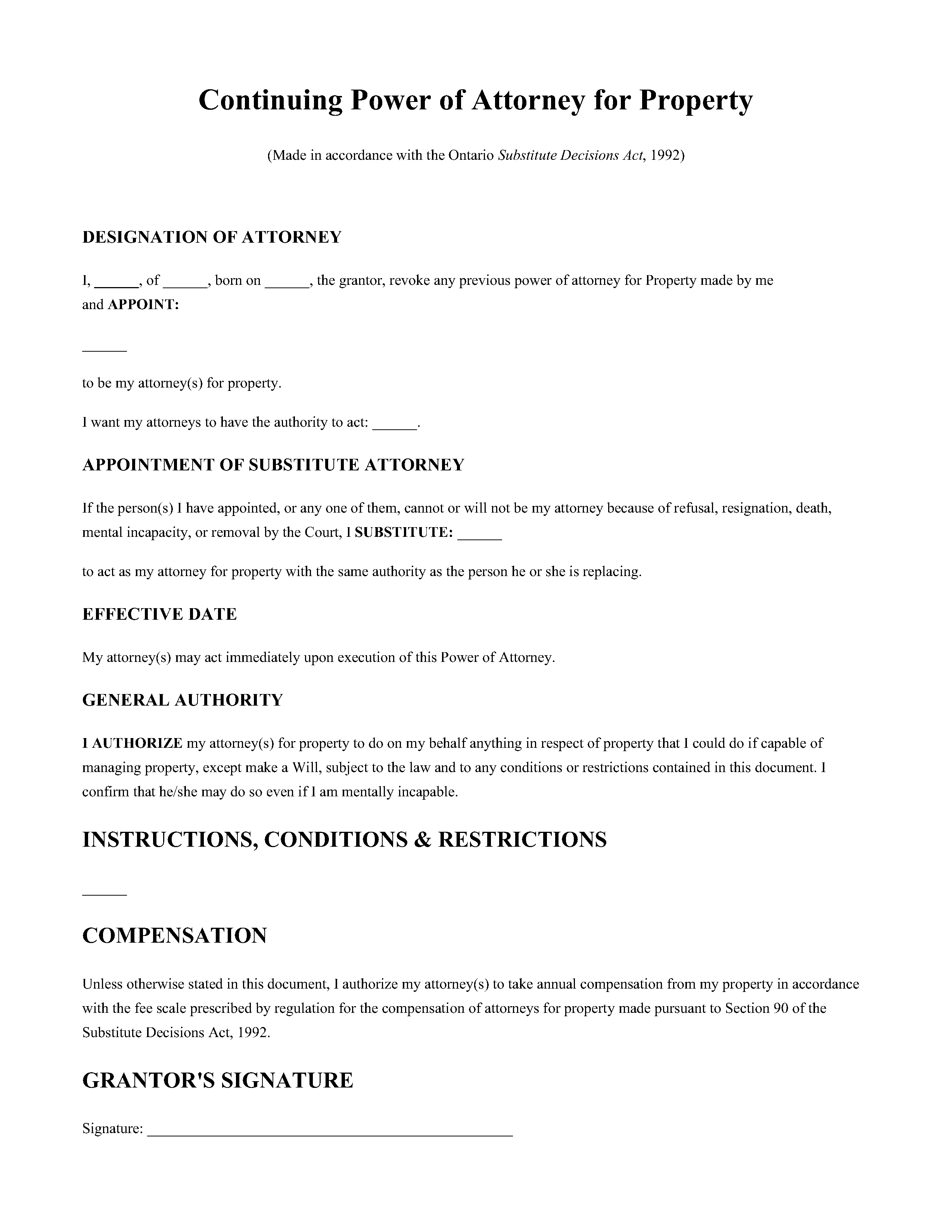
Drafting a Continuing Power of Attorney for Property is easy with our free, fillable CPOA template. We’ve outlined the essential elements and information you’ll want to include in your CPOA below.
Elements Your CPOA Must Contain
To be valid, your Continuing Power of Attorney for Property must have the following elements:
- Be called a Continuing Power of Attorney or state that it allows your Attorney to continue acting for you if you become incapacitated;
- Name one or multiple Attorneys for your property;
- Be signed and dated by you (with wet ink); and
- Be signed by two witnesses (with wet ink), who watch you sign the document.
Details to Include in Your CPOA
Include the information below in your Continuing Power of Attorney for Property:
- Granting party’s details: Full name, address, and contact details.
- Authorized party’s details: Full name, address, and contact details.
- Authorization scope: A clear description of the financial rights, permissions, or powers granted to the Attorney.
- Substitute Attorney’s details: Full name, address and contact details of the substitute Attorney in case the original one cannot fulfill their duties.
- Limitations: Note any restrictions you’d like to place on the Attorney’s permissions.
- Date of effectiveness: Add the date you’d like the Attorney to step in. This doesn’t prevent you from handling matters if you’re capable.
- Duration: If applicable, add a time frame during which the authorization is valid
- Signatures: The granting party, Attorney, and witnesses must sign and date the CPOA.
- Compensation: Attorneys are paid at a rate set out by the law unless you indicate otherwise. The current rate is 3% of funds received and paid, and 60% of 1% of an asset’s average annual value.
Note: You can choose whether your CPOA takes effect immediately upon signing or on a specific date.
Continuing POA Requirements in Ontario
To be valid, your Continuing Power of Attorney must meet the following criteria:
- Be called a Continuing Power of Attorney, or state that the Attorney’s authority continues if you become mentally incapable;
- Have physical, hand-written signatures;
- Name one or more individuals to act as your Attorney for finances;
- Be signed and dated by the person gratning CPOA; and
- Be signed by two eligible witnesses.
Note: It’s a good idea to review your Continuing POA regularly. Ensure it stays current with life changes and that instructions are up to date.
Who Can Draft a Continuing Power of Attorney for Property?
To create a Continuing Power of Attorney for Property in Ontario, you need to:
- be 18 years of age or older;
- be mentally capable of giving Power of Attorney at the time of signing; and
- sign the CPOA before two witnesses who must also sign it.
Being mentally capable of giving Continuing Power of Attorney for Property means that:
- you understand the scope of authority your Attorney will have;
- You know your Attorney must account for all the decisions they make about your property;
- you know what property you own and its approximate value;
- you understand that there is a possibility that your Attorney could misuse the authority;
- you understand that if you are capable, you may cancel your power of Attorney at any time;
- you understand that unless your Attorney manages your property prudently, its value may decrease; and
- you are aware of your obligations to the people who depend on you financially.
Who Can Witness a Continuing Power of Attorney in Ontario?
You must have two eligible witnesses sign your Continuing Power of Attorney. The witnesses cannot be:
- Your spouse, partner or someone you treat as a child
- Your Attorney or the Attorney’s spouse or partner
- Anyone under 18
- Anyone who has a Guardian of Property
- Anyone who has a Guardian of the Person
Who Cannot Witness Your Continuing POA in Ontario?
You cannot have any of the following individuals witness your CPOA:
- Your spouse or partner
- Your child, or someone you treat as a child
- Your Attorney
- Your Attorney’s spouse or partner
- Anyone under the age of 18
- A person who has a guardian of property
- A person who has a guardian of the person
Should You Notarize Your Power of Attorney in Ontario?
Having your Power of Attorney notarized is best practice; the Government of Ontario actually recommends having a notarized copy. A notarized CPOA can help things move faster, giving institutions confidence in its authenticity. You must have this document notarized in person.
Further, some institutions require a notarized copy of the CPOA before recognizing an Attorney’s authority. Notarization provides additional assurance of an Attorney’s authorization, reducing the risk of fraud.
Try NotaryPro’s Virtual Witnessing Service
Certain institutions, like banks, may refuse to recognize a POA even if it’s valid. They may require a notarized copy before accepting it.
You can have your Continuing Power of Attorney for property witnessed online in 7 minutes with NotaryPro’s convenient virtual witnessing service. We provide both witnesses; all you have to do is join the meeting with a printed copy of your CPOA. See how easy virtual witnessing can be today!
Frequently Asked Questions
You can cancel your Continuing POA at any time, provided you are mentally capable at the time of cancellation. You can learn more about how to revoke yours in our Continuing POA Guide.
In Ontario, a CPOA ends if one of the following events occurs:
- The Attorney dies, becomes incapable, or resigns (unless substitutes are named)
- A court appoints a guardian of property
- A new CPOA is signed (unless you state otherwise)
- You cancel the CPOA
Yes, if you appoint more than one Attorney, they will both have to sign off on everything. If you want them to have individual authority to make decisions, include the phrase “jointly and severally”. This way if one is sick, the other can still sign paperwork and make decisions on your behalf.
When your CPOA is completed, it’s best to leave it in a safe place that the Attorney knows about. You can leave it with their lawyer or another trusted person, but it depends on your situation. If you won’t need your CPOA for years or decades, this person may move away or die.
Yes, it is a good idea to give your bank a copy of your CPOA. The government of Ontario strongly recommends giving a copy of your CPOA to your banking institution. You should also send a copy to every financial institution you deal with.
Yes, your Attorney is entitled to payment by law. They are automatically paid 3% of the money received or paid out on your behalf. They also get 60% of 1% of your average annual asset value. They’re paid this set amount unless you note that you want to pay them a different amount, or not at all.
No, you don’t need a lawyer to create a CPOA, our template should work for most cases. However, if you own a business, have existing POA arrangements, or have a high-conflict family situation, we suggest working with a lawyer.
 for instant explanation
NOTARYPRO GUARANTEE

 215+ Downloads