

Free Ontario Separation Agreement Template
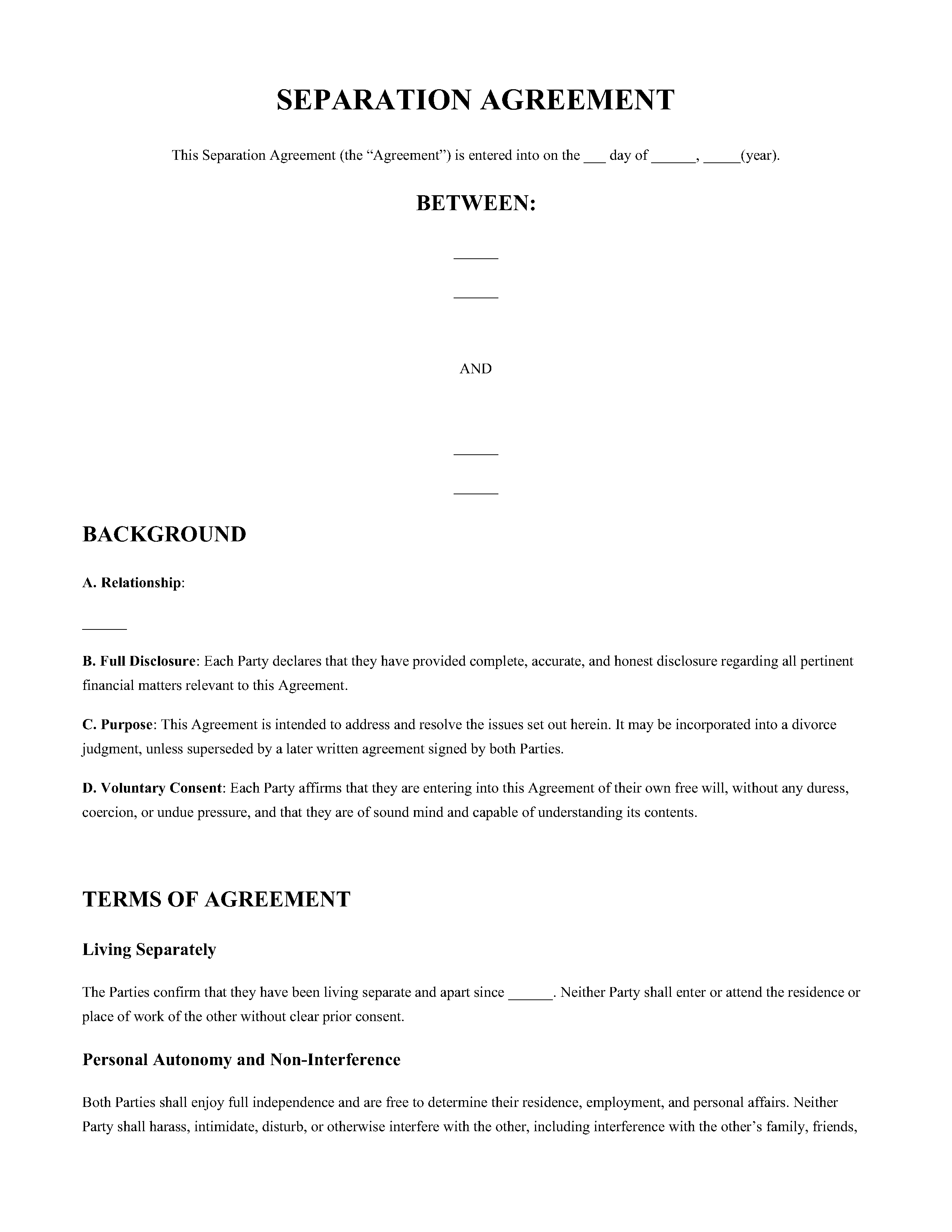
A formal legal contract for couples choosing to live separate and apart. This template allows for the detailed division of assets and debts, as well as agreements regarding support payments and living arrangements. Perfect for couples seeking a professional, out-of-court settlement to finalize their separation.
 PDF
PDF Word
Word Preview
How it Works
Fill out our simple
online form with your
information.
Review and approve
the generated
document.
Once your document
is ready, you can
Notarise!
 NOTARYPRO GUARANTEE
Contents
-
What is a Separation Agreement in Ontario?

-
Does a Separation Agreement Need to be Commissioned in Ontario?
-
What Purpose Does a Separation Agreement Serve?
-
Why Draft a Separation Agreement in Ontario?
-
Is Separation the Same as Divorce in Ontario?
-
How to Create a Separation Agreement in Ontario
-
Complete Your Separation Agreement Today
-
Frequently Asked Questions
What is a Separation Agreement in Ontario?
In Ontario, a Separation Agreement is a legally binding contract between a couple going through a separation. It details how you and your former partner will navigate life after you separate. Essentially, the agreement outlines the rights and obligations of each party to ensure both are treated fairly.
A Separation Agreement can be used by married and common-law couples, enabling them to sort out their affairs outside of court. Typically, this document summarizes how you will divide debts, assets, and parenting rights and responsibilities. It enables you and your former spouse to agree on how to navigate:
- Parenting time and decision-making responsibilities regarding your children
- Child and spousal support arrangements
- Children’s educational and moral teachings
- The division of your property
- Other matters in the settlement of your affairs (including insurance, pensions, RRSPs, RESPs, and more).
Do you have Questions about your Separation Agreement Document ?
 Create Separation Agreement Now
Does a Separation Agreement Need to be Commissioned in Ontario?
While you must sign your agreement before two adult witnesses, Ontario law doesn’t require them to be authorized officials, like notary publics. However, many legal professionals strongly recommend that you have your agreement commissioned by a notary public or other official.
Commissioning provides firm evidence of the identities of the parties named in the Agreement, helping establish the Agreement’s authenticity and validity. It reduces the risk of your agreement’s legitimacy being questioned in future disputes.
Further, commissioning is critical if you plan to use your Separation Agreement internationally. This is because commissioning may be a requirement in jurisdictions outside of Canada. This applies if you plan to use your Separation Agreement for immigration purposes or international travel.
What Purpose Does a Separation Agreement Serve?
A Separation Agreement outlines how you and your ex-spouse will handle affairs post-separation. It can help avoid conflicts and misunderstandings, offering predictability during a turbulent and confusing time. The goal is to ensure that both parties are treated fairly and that everyone knows what to expect.
Importantly, if one party doesn’t follow the agreed-upon terms, this agreement can be used to hold them accountable. Separation Agreements are governed under Part IV of Ontario’s Family Law Act. Once both parties sign a Separation Agreement, it’s viewed as a court order. This means you and your ex-partner are legally obligated to follow the agreement’s terms; if one person fails to comply, the other can take legal action. Although it’s not mandatory, you may choose to file your agreement with the court for enforcement purposes.
Why Draft a Separation Agreement in Ontario?
A Separation Agreement isn’t mandatory in Ontario, but drafting one is highly recommended. A Separation Agreement offers several benefits, including:
- Cost-Savings: Less stressful, lower legal fees, and faster than attending court.
- Greater Control: Rather than having a court decide, a Separation Agreement allows you and your ex-spouse to decide what works best for you and your family.
- Reduced Conflict: Details each person’s rights and obligations, reducing confusion, conflict, and future litigation.
- Keeping Everyone Informed: Informs everyone involved in your children’s care — including their daycare, doctors, and school — what was agreed upon.
- Proof of Arrangements: Offers concrete proof to show that the agreed-upon terms are in place.
- Legal and Financial Protection: Can be used to legally enforce arrangements between ex-spouses, such as parenting time, the division of assets, support payments, and more.
- Stability and Predictability: Provides a predictable structure for personal and financial matters, empowering you to plan for the future.
- Enhanced Privacy: Unlike attending court, a Separation Agreement can keep your private matters confidential.
Is Separation the Same as Divorce in Ontario?
Separation and divorce are often used synonymously — but legally, they refer to two different situations in Ontario. A divorce is final, while separation can be temporary.
In Ontario, you are considered legally separated once you and your ex-spouse begin living “separate and apart”. This means that each party either lives at their own place, or lives separate lives under the same roof. Living separate lives under the same roof involves having separate rooms, eating separate meals, and keeping finances separate.
If you’re in a common-law relationship, separating from your spouse ends your legal relationship. If you’re married, living apart (or separating) doesn’t end your marriage. To end your marriage, you must go to court and have a judge officially grant you a divorce.
If you are going through an uncontested divorce, both you and your ex-spouse must complete an Affidavit of Divorce (Form 36) as part of the process. An Affidavit of Divorce must be commissioned, meaning it’s signed before an authorized official, like a notary public.
You can get an Affidavit of Divorce commissioned online, from the comfort of your home. Learn about the other documents you’ll need to complete and file with the court to finalize your divorce here.
How to Create a Separation Agreement in Ontario
A Separation Agreement in Ontario includes personal information about each party and a summary of their relationship. It outlines the date you and your former spouse got married or began your relationship, and whether you share any children.
The agreement must be signed by both parties, made in writing, and witnessed by two individuals. Although the witnesses can be people you know, it’s best to have an authorized individual, like a notary public at the signing. Below are some key pieces of information you’ll want to include in your Separation Agreement:
Asset and Property Division: Outline how property and assets are divided, and how equalization payments will be made. This includes whether payments are made as one lump sum or in installments, and when.
Possession of the Matrimonial Home: This is the house where a married couple lives at the time of their separation. The agreement should note whether one party will continue to live in the home. If one party plans to remain in the home or buy the other out, the agreement should summarize the details of that arrangement.
Sale of the Matrimonial Home: If the home is being sold, include details about how you will agree on a lawyer, realtor, and price. Also, mention how the profits of the sale will be split.
Division of Debts: If you and your spouse have debts, the agreement should detail how they will be divided. Be sure to include payment schedules and payment duration.
RRSPs, RESPs, and Pensions: If you or your spouse has a pension or other savings plan, outline how these will be addressed during the separation.
Parenting Plan Information: Carefully outline the details of your parenting plan if you have one in place. For instance, where children will go to school, which extracurricular activities they’ll participate in, whether and where they’ll attend camp, and more. It’s also wise to specify what would happen if one parent decided to relocate, and how relocation would impact the parenting schedule.
Decision-Making Responsibility: Formerly known as custody, decision-making responsibility involves making major decisions about raising and caring for children. These decisions can relate to a child’s health care, education, and religion or spirituality. Noting who should make these important decisions adds clarity to the arrangement.
Parenting Time: Previously known as access, parenting time is the right to visit, or be visited by your children. It also includes the right to receive information about your child’s well-being, health, and education. Both parties should agree on parenting time and what the access schedule looks like. Be specific, outlining how much time children will spend with each party and when. Also, remember to account for holidays and vacations.
Child Support: If you’ve aligned on a basic amount for child support, include this information in the Separation Agreement. To get started, you can use the Child Support Table Look-Up. Parties should also note when child support payments will end, and which circumstances would lead to a change in payments.
A judge might refuse to grant a divorce if they don’t feel adequate child support arrangements have been put in place. A Separation Agreement can be used to prove child support arrangements to a judge.*
Conflict Resolution: Specify how you plan to resolve conflicts if you can’t agree on particular issues. Name a specific mediator or arbitrator you can turn to in case a dispute arises.
Spousal Support: Specify whether one spouse will pay the other spousal support. If so, include the start date of payments, spousal support amount, and the payment duration in the agreement. Also, mention which circumstances would lead to the termination or change of support payments.
Medical Benefits: Note whether a child remains on one or both parties’ dental and health plans for a set period. Additionally, specify how a child’s uncovered medical and dental costs will be divided.
Life Insurance: Parties may wish to include whether their spouse will remain a beneficiary on their life insurance plan. Sometimes, each party keeps the other or the children as beneficiaries.
Child Expenses: Outline extraordinary expenses for children and how they’ll be split between you and your ex-spouse. These expenses can include special needs programs, costly extracurricular activities, private school, therapy, and others. Future post-secondary education costs can be included too, as courts view post-secondary education as worthy of support.
If your case is complicated, it’s best to seek the advice of a lawyer before creating a Separation Agreement. The terms you agree to can have significant financial consequences and a powerful impact on your parental rights and responsibilities.
Complete Your Separation Agreement Today
Creating a Separation Agreement enables you to begin a new chapter and live separately from your former spouse. While separation is difficult, a Separation Agreement limits confusion, offering clarity and peace of mind.
NotaryPro makes drafting a Separation Agreement as simple as it can be. Our intuitive, fillable template is free — so you can draft one from the comfort of your home. If you already have a Separation Agreement and need to get it commissioned, consider NotaryPro’s convenient, online commissioning service.
You can meet with a notary public online and have it commissioned in under 7 minutes. Get started today and book a remote online commissioning appointment!
Frequently Asked Questions
Yes, a separation agreement becomes a legally binding contract in Ontario once it’s signed by both parties, before two witnesses. This means that you and your former partner are obligated to follow the terms of the agreement by law. If one party fails to comply with the agreement’s terms, the other can take legal action to enforce it.
If your former spouse won’t sign a Separation Agreement, they are rejecting the terms of the contract.
In this situation, it’s best to consult with a lawyer to help you understand your options. They can help you write a demand letter, explaining the consequences of not signing the agreement. If they still refuse to sign, you might need to take legal action by filing a legal notice. If they still do not sign, you may need to take the matter to court.
No, you do not need a Separation Agreement before divorce in Ontario. However, a judge may require a separation agreement to prove that you’ve made adequate arrangements regarding child support and care.
In Ontario, a Separation Agreement is used when a married or common-law couple decides to live separately. This means each party lives at their own place, or they live separately under one roof (with separate meals, finances, and sleeping arrangements).
Yes, a Separation Agreement can be commissioned online in Ontario. You can legally have your Separation Agreement commissioned online in minutes, over a secure video call with a notary public. We offer the best of both worlds: the convenience and speed of an online service with a supportive human touch.
There is no deadline to sign a Separation Agreement in Ontario. Also, you are not legally required to sign one if you don’t want to. That said, if the Agreement contains a deadline, there may be consequences for not signing it by that date. These can include the other party withdrawing their offer, changing the proposed terms, or moving toward litigation instead.
 for instant explanation
NOTARYPRO GUARANTEE

 1582+ Downloads