

Free Statutory Declaration of Translation Template
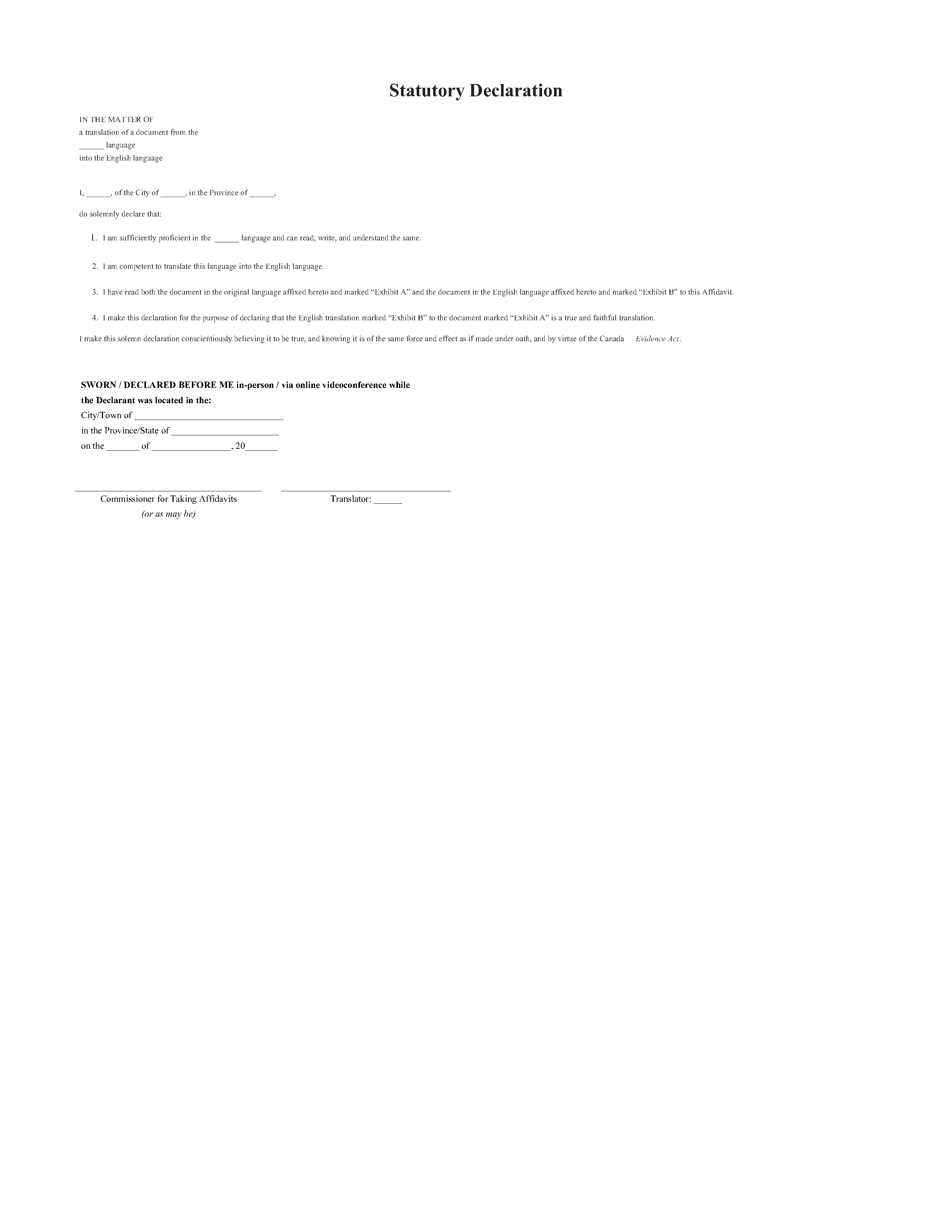
A formal legal document used by a translator to declare the accuracy of a translated document under statutory authority. Essential for verifying foreign-language evidence in administrative and regulatory matters. This template includes the required declaration of competency, document identification, and witness jurat.
 PDF
PDF Word
Word Preview
 NOTARYPRO GUARANTEE
How it Works
Fill out our simple
online form with your
information.
Review and approve
the generated
document.
Once your document
is ready, you can
Notarise!
Meet with a notary public and draft your document
Meet a licensed professional online to draft your document. Get it completed in minutes.
 $99.95
$249.00
• Save: $149.05 (60%)
$99.95
$249.00
• Save: $149.05 (60%)

Featured NotaryPro Expert in Toronto
 See how our experts help you draft
Contents
-
What is a Statutory Declaration of Translation in Canada?

-
Who Can Translate a Document in Canada?
-
Who Cannot Translate a Document in Canada?
-
When Do I Need a Statutory Declaration of Translation?
-
Situations Requiring a Statutory Declaration of Translation
-
What Details Should a Statutory Declaration of Translation Contain?
-
Getting a Statutory Declaration of Translation Commissioned
-
Who Can Commission a Statutory Declaration of Translation?
-
Commission Your Declaration With a Notary Online
-
Frequently Asked Questions
What is a Statutory Declaration of Translation in Canada?
A Statutory Declaration of Translation is a formally declared document used to verify the accuracy and completeness of a translated document. You may need it for various purposes, including but not limited to legal, immigration, academic, and business procedures.
This Declaration contains a declaration from the translator, confirming that the contents of the original document were translated correctly and not altered.
A Statutory Declaration of Translation:
- Affirms that a translation is a true and precise representation of the original document
- Validates the accuracy and integrity of a translated document
- Confirms the translator’s competence and understanding of both languages
- Assists in legal proceedings, official submissions, and transactions requiring translated documentation
Do you have Questions about your Statutory Declaration of Translation Document ?
 Create Statutory Declaration of Translation Now
Who Can Translate a Document in Canada?
In Canada, certified translators are members of provincial and territorial organizations. A translator must be fluent in the document’s original language and the target language they’re translating it into. Some authorities, including Immigration, Refugees and Citizenship Canada (IRCC) and certain courts, may require translations by certified translators only.
In many situations, the translator doesn’t need to be certified, but they must be:
- Fluent in both languages
- Independent (not the person named in the document being translated)
- Able to swear or affirm the accuracy of the translation before an authorized official
See a list of recognized provincial translation associations from the Canadian Translators, Terminologists and Interpreters Council. To learn more about certified and non-certified translator criteria, see our Guide to the Affidavit of Translation.
Who Cannot Translate a Document in Canada?
The following individuals generally cannot translate documents for immigration, court, or other official government purposes in Canada:
- The applicant
- The applicant’s family members (parents, guardians, siblings, spouses, common-law partners, conjugal partners, grandparents, children, aunts, uncles, nieces, nephews and first cousins)
- The applicant’s representatives or consultants
- The applicant’s family members are translators, lawyers, or notaries
- Translators in the process of receiving accreditation, but are not yet accredited
When Do I Need a Statutory Declaration of Translation?
Some courts, government agencies, or institutions may require a certified translator or additional credentials. If you can’t find a certified translator and will be submitting documents translated by a non-certified translator, you may need this Declaration.
You can see whether a translator is certified by checking their seal or stamp for a translator’s membership number. This number should belong to a professional translation association in Canada or abroad. Some authorities accept membership letters or registry listings instead.
Note: Always confirm the specific requirements of the authority requesting the translated document.
Situations Requiring a Statutory Declaration of Translation
You may require a Statutory Declaration of Translation when submitting documents that were originally issued in a language other than English or French. Requirements can vary depending on the receiving authority.
You might require this Declaration when submitting translated documents for the following purposes:
- Immigration applications to IRCC (visas, permanent residence, citizenship, and other applications)
- Legal matters (evidence and documents for court cases)
- Business procedures requiring corporate documents, contracts, and agreements
- Academic enrollment (sending documents as part of enrollment applications)
- Government administration (provincial programs, licensing, vital statistics)
- Professional licensing and credential assessment (regulators, certification bodies)
- Financial and banking matters (lenders, estates)
- Insurance claims (supporting documents)
- Estate and succession matters (Wills, death certificates, foreign records)
Note: Many authorities require you to submit the original document, the translated document, and the Statutory Declaration of Translation together.
What Details Should a Statutory Declaration of Translation Contain?
A Statutory Declaration of Translation typically includes the following details:
- Translator’s information: Full name, address, contact details, and certification details, if applicable.
- Original document details: Description of the original document being translated, including its title, date, and any other identifying information.
- Translated document details: Description of the translated document, specifying the language into which it has been translated.
- Translator’s affirmation: A statement affirming the translator’s competence and understanding of the original and translated language.
- Accuracy of the translation: A declaration that the translation is a true and accurate representation of the original document to the best of the translator’s knowledge.
- Signatures: The translator’s signature, date, and affirmation that the information they’ve provided is true.
- Commissioning: The signature and seal of a notary public or commissioner of oaths to certify the authenticity of the document
Getting a Statutory Declaration of Translation Commissioned
Your Statutory Declaration of Translation must be commissioned by an authorized official, like a notary public or commissioner of oaths. This is a necessary step, and without it, your Declaration isn’t valid.
During commissioning, you swear or affirm that the contents of your document are true before the notary. You’ll also sign your Declaration, the notary will witness your signature, and they’ll sign it too. Make sure you don’t sign your Declaration before your notary appointment, as you must sign in the presence of the official.
You can meet with a notary online to have your Statutory Declaration of Translation commissioned in 7 minutes, from anywhere with a Wi-Fi connection.
Who Can Commission a Statutory Declaration of Translation?
Some Canadian authorities may require you to have this declaration commissioned by a Canadian-authorized official, even if completed abroad. It’s best to check with the recipient before commissioning.
The following individuals can commission a Statutory Declaration of Translation:
In Canada
- A notary public
- A commissioner of oaths
- A commissioner for taking declarations
- A lawyer
Outside Canada
- A notary public, or the equivalent
Commission Your Declaration With a Notary Online
Don’t let commissioning stand in the way. Our platform is secure, user-friendly, and convenient. You can meet with a notary from your home or office, without commuting to an in-person location.
Book an online notary appointment to have your Statutory Declaration of Translation commissioned in minutes, from anywhere!
Frequently Asked Questions
Yes, it can, provided the receiving party requires or requests it. It’s best to check whether the receiving party requires a Declaration for non-legal documents.
Yes, a Statutory Declaration of Translation can typically be used for translations between any pair of languages. We recommend verifying the receiving party’s requirements to determine whether they have preferences for translators with expertise in specific language pairs.
A commissioned Statutory Declaration of Translation holds significant legal weight and is generally accepted as a reliable certification of translation accuracy. However, recognition may vary from country to country, so it’s best to check with the recipient institution.
 for instant explanation
NOTARYPRO GUARANTEE
Statutory Declaration of Translation
 67+ Downloads