

Mutual Release Agreement | Commission Online
 PDF
PDF Word
Word Preview
How it Works
Fill out our simple
online form with your
information.
Review and approve
the generated
document.
Once your document
is ready, you can
Notarise!
 NOTARYPRO GUARANTEE
Contents
-
What is a Mutual Release Agreement?

-
When Would I Need a Mutual Release Agreement?
-
What Does a Mutual Release Agreement Actually Release?
-
Details to Include in a Mutual Release Agreement
-
Commissioning a Mutual Release Agreement
-
Frequently Asked Questions
What is a Mutual Release Agreement?
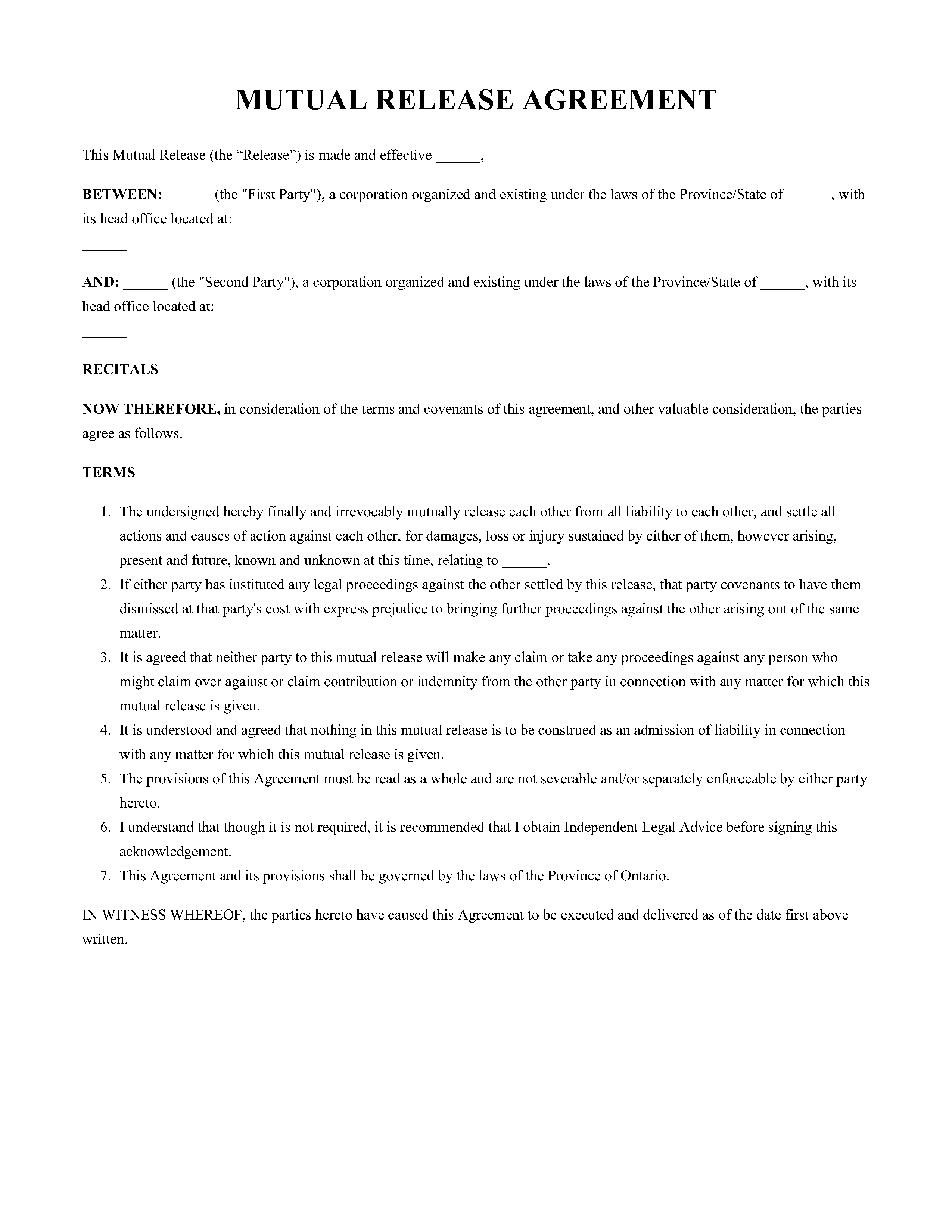
A Mutual Release Agreement is a legal document that formally resolves disputes or ends legal relationships. In it, each party agrees to release the other from certain claims, obligations, or liabilities.
This Agreement serves as a binding contract, allowing the parties to resolve matters arising from a particular event, transaction, or relationship. This enables them to move forward without enduring ongoing legal risk.
In Canada, Mutual Release Agreements are grounded in general contract law principles. This means they require mutual consent, consideration, and clear terms to be enforceable, as recognized by Canadian courts.
Typically, a Mutual Release Agreement serves the following functions:
- Resolves and terminates legal disputes or potential claims between parties
- Releases each party from further liability or legal action related to a matter
- Creates finality and certainty, reducing the risk of future litigation
Do you have Questions about your Mutual Release Agreement Document ?
 Create Mutual Release Agreement Now
When Would I Need a Mutual Release Agreement?
A Mutual Release Agreement may be appropriate for a variety of situations, including:
- Settling disputes between individuals, businesses, or organizations
- Resolving contractual disagreements and alleged breaches
- Terminating business partnerships and contractor relationships
- Concluding employment relationships
- Resolving claims related to transactions, accidents, and service issues
Note: A Mutual Release Agreement is generally not appropriate where fraud, criminal matters, or statutory rights that cannot be waived are involved. For higher-risk situations, it’s best for parties to seek independent legal advice.
What Does a Mutual Release Agreement Actually Release?
A Mutual Release Agreement is typically used for claims arising up to a specific date or event. Although releases can be drafted broadly, courts interpret them based on their context and wording.
You can draft a Mutual Release Agreement for several different types of claims. To help ensure clarity and enforceability, the Agreement should state whether it releases:
- Only known claims
- Both known and unknown claims
- Claims arising from specific events or relationships
- Claims up to and including a specific effective date
Note: Canadian courts have emphasized the importance of clear language when granting legal rights.
Details to Include in a Mutual Release Agreement
A well-drafted Mutual Release Agreement should include the following information:
- Parties involved: Full names, addresses, and contact details of all parties
- Background and context: A description of the relationship, transaction, or dispute at hand
- Release of claims: Clear language confirming that each party releases the other from specific claims, liabilities, or obligations
- Scope and effective date: The date the release takes effect and whether it applies to past, present, or future claims
- Confidentiality and non-disparagement: Confidentiality terms of the agreement and restrictions on negative statements (if applicable)
- Voluntary agreement statement: A statement to reflect that the parties entered into the Agreement freely, without pressure
- Independent legal advice: Acknowledgement that each party had the opportunity to seek legal advice (optional but recommended)
- Governing law: A note about which provincial laws apply to the agreement
- Signatures and dates: The signatures of all parties involved
Commissioning a Mutual Release Agreement
A Mutual Release Agreement doesn’t generally need to be commissioned to be legally valid. Under Canadian contract law, enforceability depends on mutual consent, consideration, and clear terms.
That said, commissioning the Agreement can help support its validity in court, giving it added credibility for future disputes. If the Agreement is challenged, a commissioned document typically carries greater weight because commissioning reduces claims about authenticity, forgery, or improper execution.
We especially recommend commissioning for higher-stakes agreements, serious dispute settlements, and situations where enforceability may later be questioned.
You can meet with a notary public online and have your Mutual Release Agreement commissioned in 7 minutes from anywhere.
Frequently Asked Questions
Yes, a Mutual Release Agreement can be used to waive future claims between parties. Be sure to draft the Agreement carefully and ensure it clearly reflects the intent to waive future claims.
Yes, you can use a mutual release agreement to resolve employment-related disputes, including wrongful termination, severance, and discrimination claims. However, specific employment rights and protections under employment standards legislation cannot be waived by a mutual release agreement.
It’s best to consult legal counsel before entering into any agreement related to an employment dispute.
If one party breaches a mutual release agreement by making additional claims or initiating legal action, the other party may have grounds to seek legal action.
We recommend consulting legal counsel to look at the options available in the event of a breach.
 for instant explanation
NOTARYPRO GUARANTEE

 26+ Downloads