

Free Statutory Declaration of Common-Law Union Template
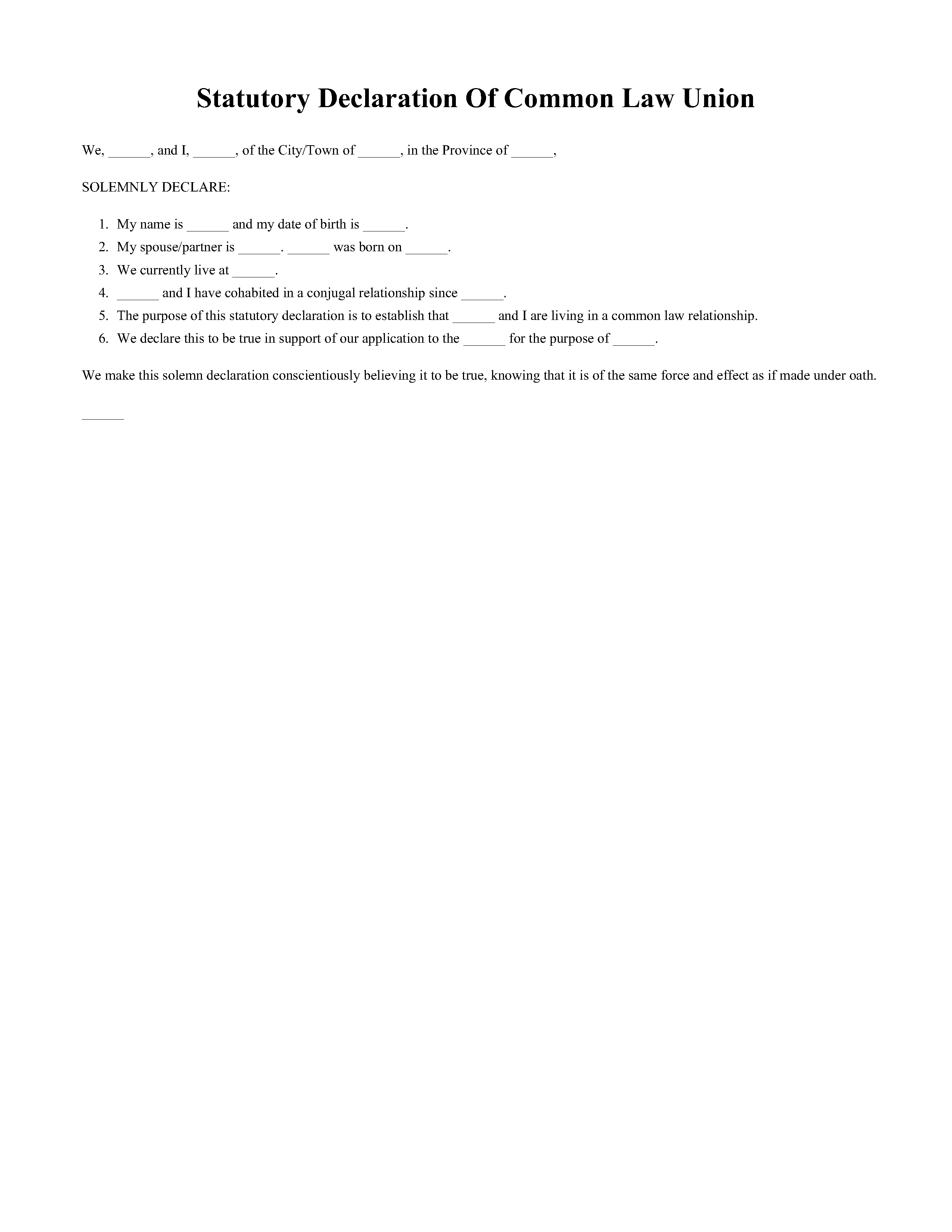
A formal sworn statement used to legally verify a common-law relationship. Required for immigration, tax filing, and insurance enrollment. This template includes the mandatory fields for cohabitation dates, joint asset declarations, and the formal notary jurat for official verification.
 PDF
PDF Word
Word Preview
 NOTARYPRO GUARANTEE
How it Works
Fill out our simple
online form with your
information.
Review and approve
the generated
document.
Once your document
is ready, you can
Notarise!
Meet with a notary public and draft your document
Meet a licensed professional online to draft your document. Get it completed in minutes.
 $99.95
$249.00
• Save: $149.05 (60%)
$99.95
$249.00
• Save: $149.05 (60%)

Featured NotaryPro Expert in Toronto
 See how our experts help you draft
Contents
-
What is a Statutory Declaration of Common-Law Union in Canada?

-
What is a Common-Law Relationship in Canada?
-
When Do You Need a General Statutory Declaration of Common-Law Union
-
Details Required in a Statutory Declaration of Common-Law Union
-
Commissioning a Statutory Declaration of Common-Law Union
-
Frequently Asked Questions
What is a Statutory Declaration of Common-Law Union in Canada?
A general Statutory Declaration of Common-Law Union is a legal document that provides evidence of a common-law relationship between two people. It helps establish the authenticity and duration of their relationship for legal, regulatory, and administrative purposes.
It’s a custom, sworn document in which both partners solemnly declare they’ve been living together in a committed relationship, similar to a marriage.
Unlike prescribed government forms (e.g., IMM 5409), a general Statutory Declaration of Common-Law Union supports a variety of purposes, including:
- Legal matters and court cases
- Administrative or regulatory procedures
- Family law matters
- Accessing or asserting rights that exist under provincial law
- Providing sworn evidence of a common-law relationship where no prescribed government form applies
- Insurance, benefits enrolment, estate planning, and non-government pension or retirement plans, where no prescribed government form applies
Do you have Questions about your Statutory Declaration of Common-Law Union Document ?
 Create Statutory Declaration of Common-Law Union Now
What is a Common-Law Relationship in Canada?
The definition of common-law varies depending on which province or territory you’re in, and why you need to prove common-law status.
There’s no single definition of common-law status in Canada because common-law criteria vary across provinces and territories. Common-law rules also differ at the federal level, depending on why you need to demonstrate common-law status.
For example, IRCC requires a couple to live together for one year before becoming common-law, even if they share a child. Conversely, CRA considers a couple to be common-law after cohabiting for one year or sooner if they share a child.
To add to the confusion, Canadian provinces and territories also use a different set of criteria to define common-law status. For instance, Ontario’s Family Law Act requires a couple to live together continuously for three years (or one year if they share a child). By contrast, British Columbia recognizes common-law spouses after two years of cohabitation (or immediately if a couple shares a child).
It’s best to check how the organization requesting the Statutory Declaration defines a common-law relationship before proceeding.
When Do You Need a General Statutory Declaration of Common-Law Union
A general Statutory Declaration of Common-Law Union is typically used only when no prescribed government form applies. It’s not typically used for government-run immigration, taxation, pension, or old-age security matters. Those situations have their own processes or prescribed government forms.
You may need a General Statutory Declaration of Common-Law Union for the following:
- Employer or union benefits enrolment: Where you need to prove your common-law relationship, and no specific form is provided.
- Private insurance matters: For enrolment, beneficiary designation, coverage eligibility, and claims.
- Estate planning and estate administration: Where you need to prove common-law status for Wills, estates, or succession planning.
- Private or employer-administered retirement and pension: Where plans are not governed by the Canadian Pension Plan or Old Age Security.
- Banking, lending, or contractual matters: For co-borrowing arrangements, guarantees, or contracts where relationship status affects financial rights or obligations.
- Family law or civil cases: Where sworn evidence of your common-law relationship is required, and no prescribed statutory form exists.
- Housing, real estate, or tenancy matters: To confirm common-law status for joint tenancies, lease applications, occupancy rights, or related contractual requirements.
- Administrative and regulatory processes: Any requests for sworn confirmation of a common-law relationship that don’t mandate a specific government form
Acceptance of a general Statutory Declaration of Common-Law Union depends on the requesting authority’s requirements.
Details Required in a Statutory Declaration of Common-Law Union
A Statutory Declaration of Common-Law Union requires a couple to provide specific details about themselves and the nature of their relationship. Each partner must sign the declaration and provide the following:
- The Location of the Declaration: The country and province where the declaration is being made.
- Personal Information: Both partners’ full legal names, current address, and dates of birth.
- Cohabiting Relationship Duration: The length of time the couple has been in a common-law relationship, and the date they began living together.
- A Solemn Statement: The declarants (person making the declaration) and their partner must declare that the information they’ve provided is true. The couple makes a solemn statement before a notary public and then signs the declaration in their presence.
- Commissioning: The authorized official confirms each partner’s identity and witnesses their signatures. The official also provides their full name, signature, and official stamp to certify the declaration’s validity.
Commissioning a Statutory Declaration of Common-Law Union
Your Statutory Declaration of Common-Law Union must be commissioned by an authorized official, like a notary public or commissioner of oaths. This is a necessary step, and without it, your Declaration isn’t valid.
You can meet with a notary online to have your Declaration commissioned in 7 minutes, from anywhere with a Wi-Fi connection. Note: Remote commissioning rules can vary based on provincial law. Always check your local laws to ensure they permit online commissioning.
How Commissioning Your Declaration Works
You can commission your Declaration online through a secure video appointment. During your online notary appointment, the following will take place:
- You’ll present a piece of valid, government-issued ID to verify your identity.
- You’ll solemnly declare that the contents of your Declaration are true.
- You’ll confirm that you understand the document and are signing voluntarily.
- You’ll sign and date the Declaration while a notary witnesses in real time.
- A notary signs and applies their official stamp or seal.
To learn more about the commissioning process, check out our guide.
Note: Knowingly providing false information may be considered perjury under Canada’s Criminal Code.
Frequently Asked Questions
No. A general Statutory Declaration of Common-Law Union is not the same as IMM 5409. IMM 5409 is a prescribed government form used only for Canadian immigration and family sponsorship applications. You cannot use a general General Statutory Declaration of Common-Law Union in these cases.
No. A statutory declaration does not create or register a common-law relationship. Common-law status arises when your relationship meets certain federal or provincial rules. The Declaration serves as evidence that you meet these regulations.
 for instant explanation
NOTARYPRO GUARANTEE
Statutory Declaration of Common-Law Union
 1078+ Downloads