

Free Statutory Declaration Template
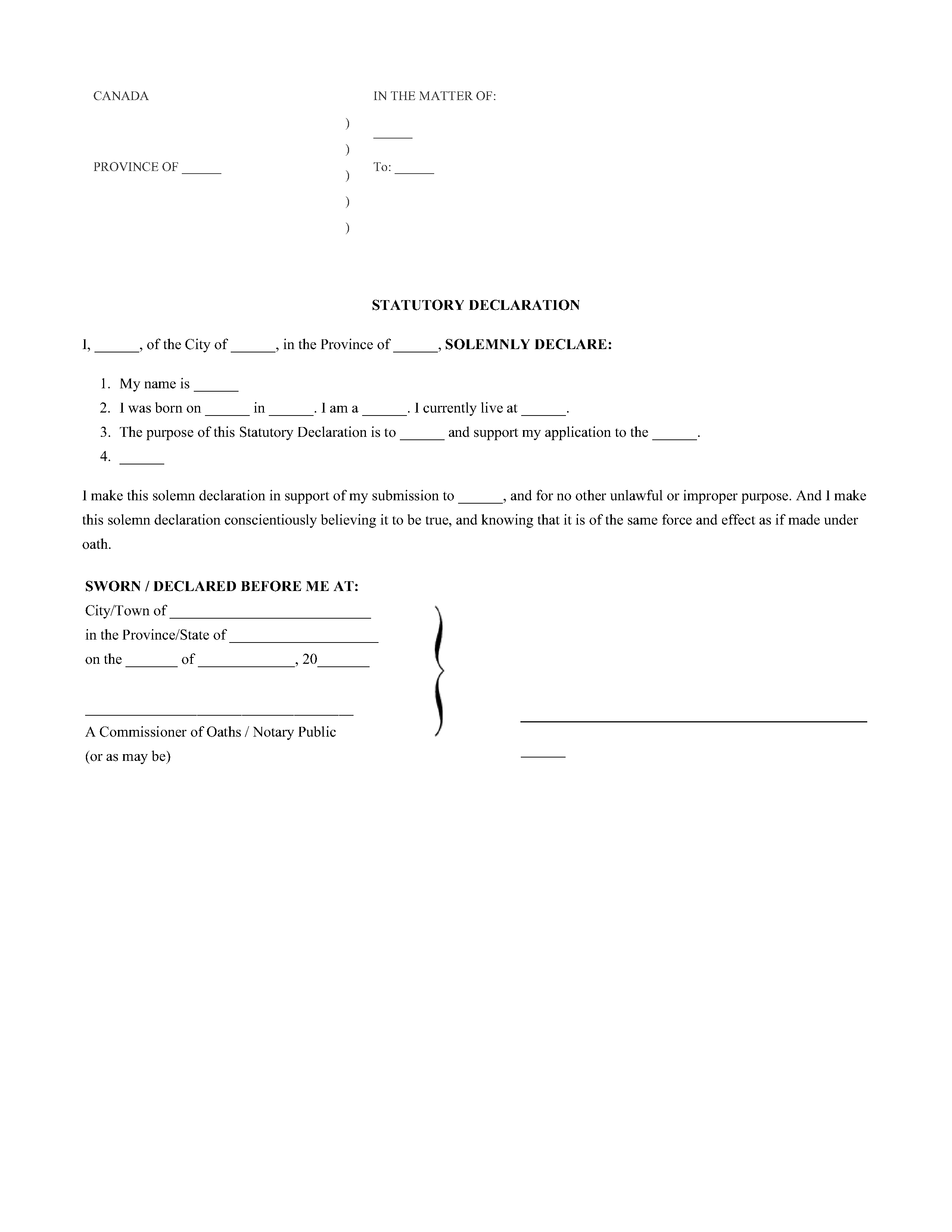
A formal document defined by statute for declaring the truth of any fact or matter. This template provides the necessary structure, including the declaration statement and the witness signature block, required for official use in administrative, commercial, and private legal matters.
 PDF
PDF Word
Word Preview
 NOTARYPRO GUARANTEE
How it Works
Fill out our simple
online form with your
information.
Review and approve
the generated
document.
Once your document
is ready, you can
Notarise!
Meet with a notary public and draft your document
Meet a licensed professional online to draft your document. Get it completed in minutes.
 $99.95
$249.00
• Save: $149.05 (60%)
$99.95
$249.00
• Save: $149.05 (60%)

Featured NotaryPro Expert in Toronto
 See how our experts help you draft
Contents
-
What is a Statutory Declaration in Canada?

-
Does a Statutory Declaration Need to Be Commissioned?
-
The Purpose of a Statutory Declaration in Canada
-
How to Create a Statutory Declaration in Canada
-
Affidavit vs. Statutory Declaration
-
When Do I Need a Statutory Declaration in Canada?
-
Frequently Asked Questions
What is a Statutory Declaration in Canada?
In Canada, a Statutory Declaration is a legal document that contains a written statement of facts, circumstances, or events. The declarant (person making the declaration) officially declares that the information they provide in their statement is truthful and accurate.
This document must be commissioned by an official authorized to administer oaths and affirmations by law. During commissioning, the declarant swears or affirms that the contents of their Declaration are true before the official. Therefore, a Statutory Declaration has the same legal weight as a sworn or affirmed statement made under oath. It may be relied upon as legal evidence, depending on the context and receiving authority.
Do you have Questions about your Statutory Declaration Document ?
 Create Statutory Declaration Now
Does a Statutory Declaration Need to Be Commissioned?
Yes, a Statutory Declaration must be commissioned by an authorized official, like a notary public. Once you declare that the contents of your Statutory Declaration are true before an authorized official, they’ll witness your signature and sign it. They’ll also print their name and add an official seal to the document.
Telling the truth in your Statutory Declaration is important, as knowingly providing false information is considered perjury, a criminal offence. To learn what you can expect during your notary appointment, see our Statutory Declaration guide. You can commission your Statutory Declaration online in 7 minutes with NotaryPro.
The Purpose of a Statutory Declaration in Canada
This instrument is used for various purposes, often to satisfy legal, administrative, or governmental requirements. It is relied upon by individuals, organizations, and government authorities for specific legal, administrative, or regulatory purposes.
You might submit a Statutory Declaration to provincial or federal government agencies, financial institutions, and employers. A Statutory Declaration is sometimes required to receive certain rights or privileges, access government benefits, or prove your relationship to immigration authorities.
Some other circumstances that may require a Statutory Declaration include but aren’t limited to the following:
Legal and Administrative Purposes
- Declaring your relationship status
- Legally changing your or your child’s name
- Making a declaration of residency
- Proving that someone has passed away
- Confirming your identity
- Verifying the accuracy of information or documents
- Applying for a pension
- Establishing that you no longer live with your former spouse
- Updating your legal gender
- Confirming parentage or guardianship where no court order exists
Declaring that official documents are missing
- Verifying birth details (date and location)
Financial Purposes
- Providing evidence of financial status or assets owned
- Completing insurance claims
- Declaring the source of certain funds for financial institutions
- Confirming no debts or liabilities for transactions
- Declaring asset ownership
- Confirming financial dependency or support
Declaring loss of financial documentation (e.g., bonds, certificates)
Business Purposes
- Affirming the merger or consolidation of two or more legal entities
- Declaring the types of goods being exported or imported into a country
- Affirming the signing authority for a corporation or organization
- Confirming beneficial ownership of a business
- Proof of corporate address or principal place of business
- Declaring the accuracy of corporate records
Immigration Purposes
- Helping a family member come to Canada as a refugee
- Declaring that you have translated a document accurately and truthfully
- Declaring relationship status (spouse, common-law partner, dependent)
- Confirming cohabitation history
- Declaring intent to sponsor or provide support
- Confirming identity when documents are unavailable
- Declaring travel history when records are incomplete
How to Create a Statutory Declaration in Canada
Creating a Statutory Declaration is relatively simple. Importantly, it’s critical to ensure the information you include is accurate and truthful. Making a false declaration is an offence in Canada; a Statutory Declaration holds the same legal weight as a statement made under oath and has value as evidence.
The details required vary depending on the reason for your declaration, and the legal or administrative context in which it’s being used. Ensure you include all the required details in your Statutory Declaration to safeguard its validity and avoid disputes. In Canada, a Statutory Declaration should include the following details:
- A Clear Title: Your declaration should be named “Statutory Declaration”.
- The Declarant’s Details: It should include their legal name, current province, city, and address. It should also include the declarant’s date of birth, place of birth, and citizenship status.
- Its Purpose: The reason for making the declaration and all relevant details concerning the matter.
- A Statement of Facts: A clear and concise written account of the details you want to outline.
- The Recipient of your Statutory Declaration: Provide the institution or entity you plan to send your Statutory Declaration to.
- Declarant’s Signature: You must make a solemn statement to affirm that the contents of your declaration are true. You need to do this before an authorized official, like a notary public, and then sign your declaration in front of them.
- Commissioning: Once you affirm that the contents of your declaration are true, a notary public will verify your identity. They will also sign the declaration, print their name, and add an official seal. You can commission your declaration online, in 7 minutes with NotaryPro.
Once your declaration is completed and signed, keep it for your records. If you’re unsure whether you’ve included the correct details, it’s best to speak with a professional. At NotaryPro, we offer Expert Document Drafting, where a trusted expert drafts a document for you during an online video session. Simply start your Statutory Declaration draft, and select the Expert Document Drafting option for extra peace of mind.
Affidavit vs. Statutory Declaration
Statutory Declarations and Affidavits have several similarities. Both are written statements of fact that present information with numbered sentences and paragraphs. Both documents must be affirmed to be true before an authorized official, who must witness, sign, and stamp them for them to be considered valid. Affidavits and Statutory Declarations are subject to the rules of evidence in Canadian provincial and federal courts. Therefore, providing a false or misleading Statutory Declaration or Affidavit can be considered a criminal offence.
However, there are also key differences between a Statutory Declaration and an Affidavit. A Statutory Declaration is typically used outside of court, while an Affidavit is mainly used for legal proceedings. However, both may be accepted depending on the context and on legal requirements.
Another difference is that a person making a Statutory Declaration is called a declarant. When someone makes an Affidavit, they’re called an affiant. Both affiants and declarants swear or affirm facts to be true. Additionally, Statutory Declarations are solemn statements, while Affidavits are solemn affirmations or oaths.
When Do I Need a Statutory Declaration in Canada?
In Canada, you need a Statutory Declaration to confirm that the facts you are declaring are accurate, usually to satisfy legal or regulatory requirements. You might need to submit one to provincial or federal government agencies, financial institutions, employers, and other organizations to complete certain processes.
These processes can enable you to access government benefits, receive certain rights or privileges, or prove your relationship to immigration authorities. Statutory Declarations are authorized by the Canada Evidence Act and provincial evidence acts. A notary public or commissioner of oaths can receive a declaration from anyone voluntarily making one.
Frequently Asked Questions
A Statutory Declaration is required for various legal, regulatory, or administrative circumstances. You may need to submit a Statutory Declaration to courts, provincial or federal government agencies, financial institutions, employers, and other organizations to complete certain processes. It can be required to access government benefits, rights or privileges, prove your relationship to immigration authorities, and more.
Yes, a Statutory Declaration can be commissioned online in Canada. You can legally have your statutory declaration commissioned online in minutes, over a secure video call with a notary public. We offer the best of both worlds: the convenience and speed of an online service with a supportive human touch.
It depends on the purpose of the Statutory Declaration. Sometimes, an individual must make their Statutory Declaration in Canada before an authorized official, like a notary public. In other cases, it may be possible to make the declaration before an authorized official outside of Canada. It’s a good idea to consult with a legal professional to determine the specific requirements for your unique situation.
Under Canadian law, Statutory Declarations don’t generally have an automatic expiry date. Their length of validity depends on the purpose for which the declaration is needed. The recipient organization (government department, court, etc.) decides how recent it must be.
A Canadian Statutory Declaration might be accepted outside of Canada, depending on the purpose and the recipient country’s requirements. Some foreign authorities require declarations to be notarized, authenticated, or accompanied by additional certifications. It’s best to verify international acceptance requirements before submitting a Statutory Declaration abroad.
 for instant explanation
NOTARYPRO GUARANTEE
 2312+ Downloads