

Free Certificate of Incumbency Template
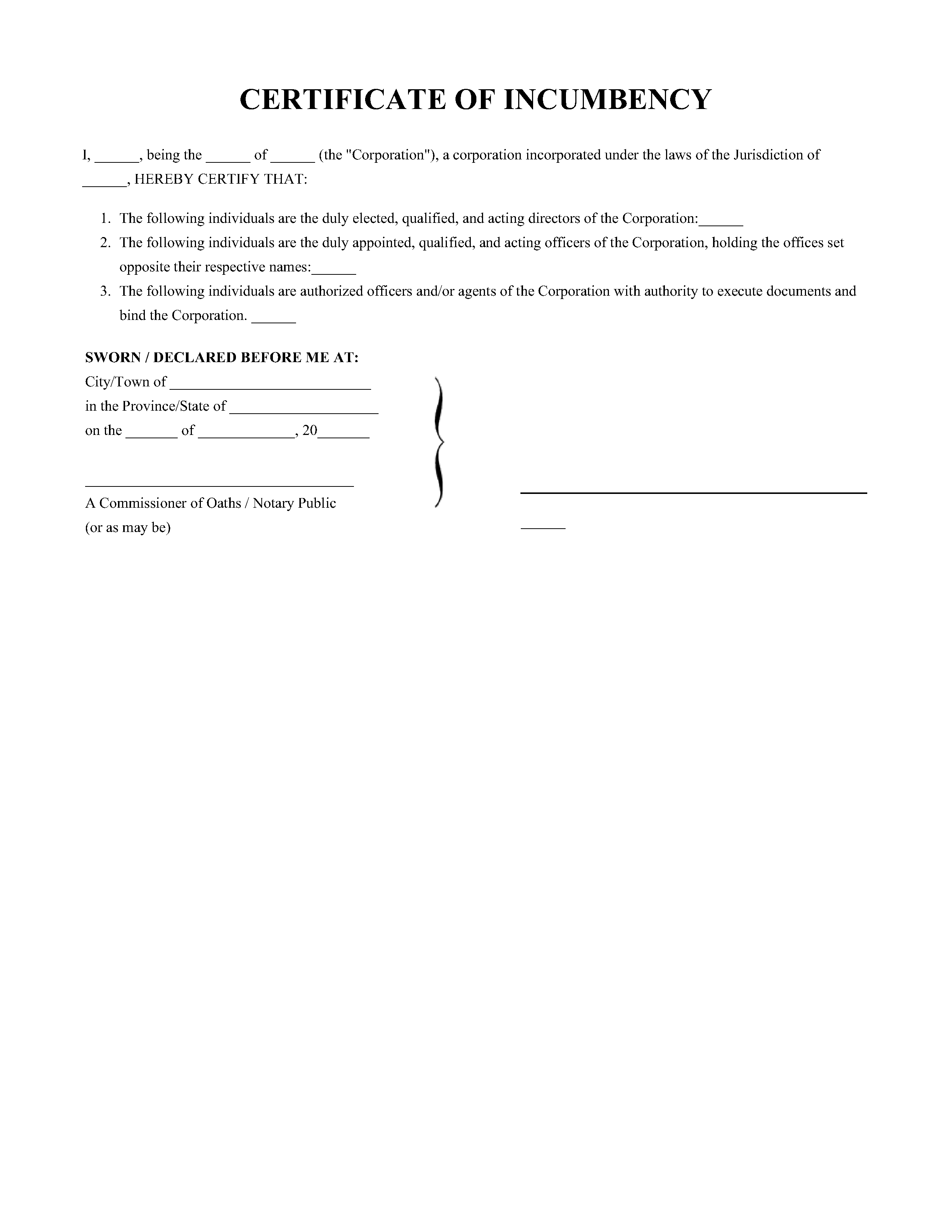
A corporate document used to confirm the identity and authority of a company’s directors and officers. Essential for banking, real estate transactions, and legal contracts. This template includes a table for names, titles, and specimen signatures to verify authorized signatories for the corporation.
 PDF
PDF Word
Word Preview
 NOTARYPRO GUARANTEE
How it Works
Fill out our simple
online form with your
information.
Review and approve
the generated
document.
Once your document
is ready, you can
Notarise!
Meet with a notary public and draft your document
Meet a licensed professional online to draft your document. Get it completed in minutes.
 $99.95
$249.00
• Save: $149.05 (60%)
$99.95
$249.00
• Save: $149.05 (60%)

Featured NotaryPro Expert in Toronto
 See how our experts help you draft
Contents
-
What is a Certificate of Incumbency?

-
What is the Purpose of a Certificate of Incumbency?
-
What Does “Authority to Act” Mean?
-
Third Parties Who May Request a Certificate of Incumbency
-
Who Can Sign a Certificate of Incumbency?
-
Details to Include in Your Certificate of Incumbency
-
Which Entities Can Issue this Certificate?
-
Commissioning a Certificate of Incumbency
-
Draft and Commission Your Certificate Today
-
Frequently Asked Questions
What is a Certificate of Incumbency?
A Certificate of Incumbency is a corporate document that confirms the authority and status of individuals holding key positions within a company. It outlines which individuals hold significant positions and have the authority to act on its behalf. This certificate may be required by financial institutions, regulatory bodies, or other entities for various business transactions.
This Certificate is also sometimes known as an:
- Incumbency Certificate
- Officer Certificate
- Secretary’s Certificate
Do you have Questions about your Certificate of Incumbency Document ?
 Create Certificate of Incumbency Now
What is the Purpose of a Certificate of Incumbency?
This document lists the individuals authorized to act on behalf of their organization. It helps third parties verify an individual’s authority to represent a company when facilitating various processes and transactions.
A Certificate of Incumbency serves multiple purposes, including:
- Preserving corporate governance: It verifies the authority of individuals within a company, facilitating transparency and accountability.
- Authorizing Legal Transactions: It helps complete corporate transactions like mergers, acquisitions, or financing arrangements.
- Validating Banking and Financial Processes: It facilitates loan approvals, corporate account openings, and more.
- Supporting International Transactions: It confirms a person’s authority to sign off on international transactions.
What Does “Authority to Act” Mean?
Authority to act refers to the powers a corporation has formally given an individual through its bylaws, resolutions, or governing documents. This authority may allow an individual to take the following actions:
- Sign contracts, agreements, or filings on behalf of the corporation
- Represent the corporation in dealings with regulators, banks, or counterparties
- Make binding decisions
- Carry out specific actions authorized by corporate resolutions or policies
Note: A Certificate of Incumbency does not create authority. It only confirms authority that already exists. Who Can Be Named in a Certificate of Incumbency? A Certificate of Incumbency typically lists any of the following individuals:
- President or Chief Executive Officer
- Managing Director
- Corporate Secretary
- Treasurer or Chief Financial Officer
- Directors
- Other senior officers or authorized signatories
- As permitted by the company’s bylaws or resolutions
Third Parties Who May Request a Certificate of Incumbency
The following organizations may require you to provide a Certificate of Incumbency:
- Government offices
- Regulatory bodies
- Banks and financial institutions
- Contractual counterparties (other businesses, etc.)
- Law firms and legal representatives
- Courts and tribunals
- Corporate service providers
- Insurance companies
- Investors, lenders, or funding bodies
- Educational institutions and research partners
- Non-profit or charitable oversight bodies
Protecting Third Parties
Confirmation that a person has proper authority also protects third parties by:
- Reducing reliance risk (i.e. trusting that someone has the authority they claim to have)
- Creating legal accountability for inaccurate representations made by the corporation
- Supporting the enforceability of contracts if the authority is challenged later
Let’s say a dispute arises, and the corporation claims that a certain person didn’t have the authority to act. A Certificate of Incumbency provides evidence that:
- An individual had the authority to act at the time of signing
- Individuals named in the Certificate were with the company at the time of the action
- A third party acted in good faith
Who Can Sign a Certificate of Incumbency?
The following list of individuals can sign a Certificate of Incumbency:
- A director
- A corporate officer with signing authority (e.g., president, CEO, secretary, treasurer)
- An individual authorized to certify corporate records (e.g., a corporate secretary)
Details to Include in Your Certificate of Incumbency
A Certificate of Incumbency contains information about an organization’s incumbent individuals, including its officers, directors, and other leaders. Include each authorized person’s name and position within your company.
Here are some specific details you’ll want to include in your Certificate of Incumbency:
- The corporation’s legal name
- Authorized individuals’ names, titles, and signatures
- The date
- The province where the signing took place (indicating which laws apply)
- The corporation’s jurisdiction of incorporation
- Confirmation that the individuals named currently hold the stated positions
- Statement that bylaws or resolutions authorize the authority
Which Entities Can Issue this Certificate?
The following registered entities may issue this Certificate:
- Corporations
- Non-profit corporations
- Charitable organizations
- Limited partnerships
- Limited liability partnerships
- Extra-provincial corporations (foreign corporations registered to do business in a province)
- Professional corporations (law, accounting, etc.)
- Crown corporations or government-owned entities (where permitted)
- Trusts (a trustee must prove authority to sign)
- Joint ventures (when structured as a registered entity)
General partnerships don’t typically rely on this Certificate in the same way, as partners in a partnership usually have inherent authority under partnership law. However, third parties may still request a similar document to confirm authority, especially when:
- Authority is restricted by a Partnership Agreement
- Only certain partners may bind the partnership
Commissioning a Certificate of Incumbency
A Certificate of Incumbency can be commissioned by an authorized official, like a notary public or commissioner of oaths. This step may be mandatory, depending on the recipient organization’s requirements. It’s best to check with the third party requesting this Certificate.
That said, we highly recommend having your Certificate of Incumbency commissioned. This strengthens the document''s validity if disputes ever arise down the road.
You can meet with a notary online to have your Certificate of Incumbency commissioned in 7 minutes, from anywhere with a Wi-Fi connection.
How Commissioning Your Certificate Works
You can commission your Certificate online through a secure video appointment. During your online notary appointment, the following will take place:
- You’ll present a piece of valid, government-issued ID to verify your identity.
- You’ll swear or affirm that the contents of your Certificate are true.
- You’ll confirm that you understand the document and are signing voluntarily.
- You’ll sign and date the Certificate while a notary witnesses in real time.
- A notary signs and applies their official stamp or seal.
To learn more about the commissioning process, check out our guide.
Draft and Commission Your Certificate Today
Now it’s time to take the next step! Use our free Certificate of Incumbency template to draft your document in minutes. Then, meet with a notary public online to have your Certificate of Incumbency commissioned in under 7 minutes!
Frequently Asked Questions
Various parties, including banks, financial institutions, business partners, and government agencies, might request one. They might do so to verify a company’s current officers, directors, and sometimes, other authorized signatories for legal and financial purposes.
Many recipients require a Certificate of Incumbency to be recent. This typically means that it’s dated within the last 30–90 days.
A Certificate of Incumbency shows who holds authority to act within the corporation. An Affidavit of Corporate Signing Authority confirms that a particular person has the authority to sign a document.
 for instant explanation
NOTARYPRO GUARANTEE
 74+ Downloads