

Free Cross-Border Vehicle Permission Template
A formal authorization letter used when a driver is taking a vehicle they do not own across the border. Required for borrowed cars, company vehicles, and leased transport. This template includes all necessary fields for owner consent, vehicle specifications, and travel dates to satisfy customs requirements.
 PDF
PDF Word
Word NOTARYPRO GUARANTEE
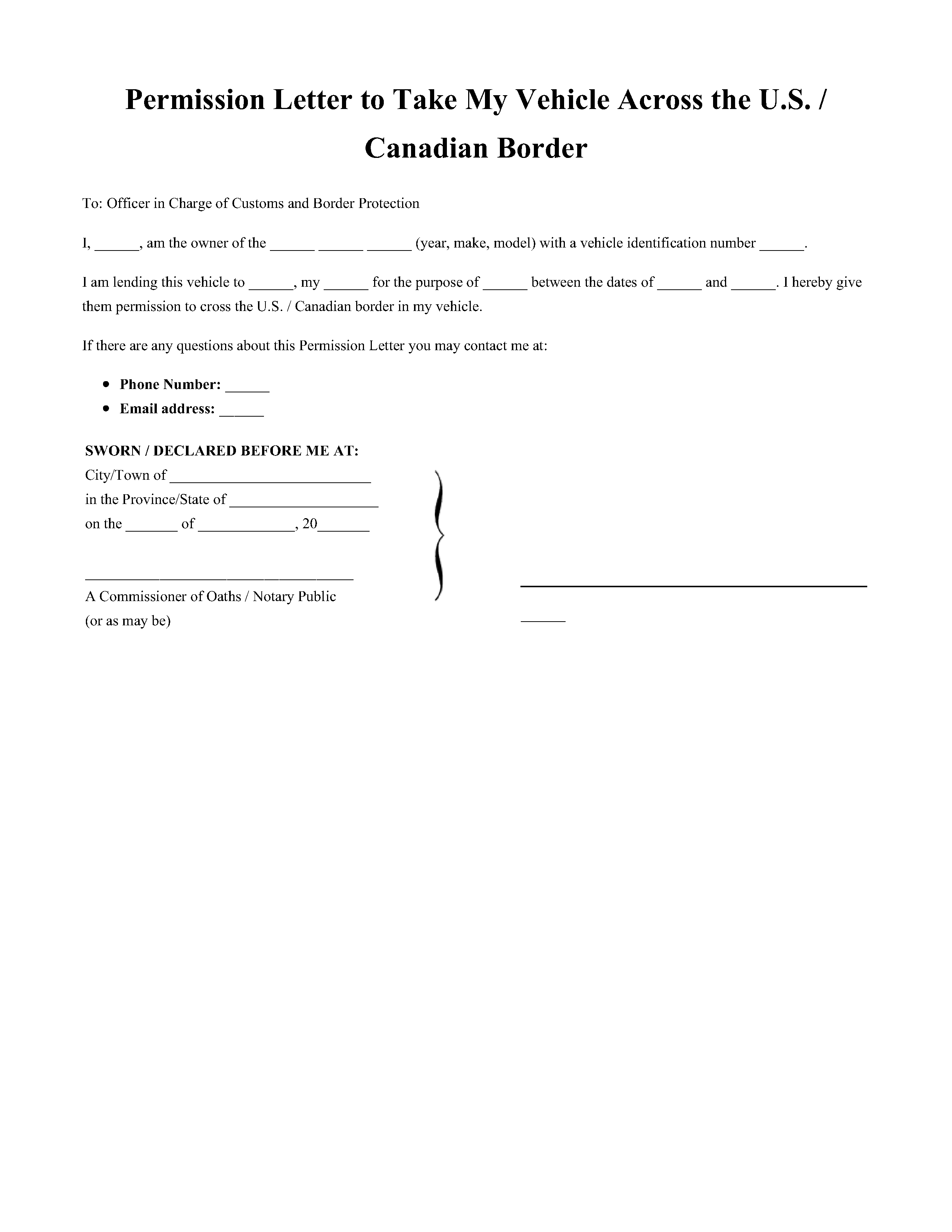
 Preview
Meet with a notary public and draft your document
Meet a licensed professional online to draft your document. Get it completed in minutes.
 $99.95
$249.00
• Save: $149.05 (60%)
$99.95
$249.00
• Save: $149.05 (60%)

Featured NotaryPro Expert in Toronto
 See how our experts help you draft
 NOTARYPRO GUARANTEE
How it Works
Fill out our simple
online form with your
information.
Review and approve
the generated
document.
Once your document
is ready, you can
Notarise!
Meet with a notary public and draft your document
Meet a licensed professional online to draft your document. Get it completed in minutes.
$99.95
$249.00
• Save: $149.05 (60%)
Featured NotaryPro Expert in Toronto
See how our experts help you draft
Contents
-
Cross-Border Vehicle Permission Letter for Canada or the U.S.?

-
How to Use a Cross-Border Vehicle Permission Letter
-
Does This Letter Need to Be Commissioned or Notarized?
-
How to Draft a Cross-Border Vehicle Permission Letter
-
Frequently Asked Questions
Cross-Border Vehicle Permission Letter for Canada or the U.S.?
A Cross-Border Vehicle Permission Letter shows that you have permission to take a vehicle that you don’t own across the border.
This letter must be completed by the vehicle’s owner, who signs and dates the letter. While not always legally required, both Canadian and U.S. border services recommend carrying this letter to avoid delays and entry refU.S.ls.
Essentially, a Cross-Border Vehicle Permission Letter helps border officials confirm that:
- The driver has the owner’s permission to use the vehicle, and
- The vehicle is not stolen or being taken across the border without authorization.
Do you have Questions about your Cross-Border Vehicle Permission Letter | Canada + U.S. Document ?
 Create Cross-Border Vehicle Permission Letter | Canada + U.S. Now
How to Use a Cross-Border Vehicle Permission Letter
Using a Cross-Border Vehicle Permission Letter is simple. Follow the steps below to help ensure a smooth crossing experience.
Before You Travel
- Make sure the name and signature on your letter match those on the vehicle ownership or registration.
- Bring an extra copy of the letter in case one is retained or damaged.
- Carry the vehicle ownership, registration, and insurance documents.
- If driving a company vehicle, bring proof that you’re an employee or director
At the US-Canada Border
You don’t need to automatically present the permission letter when you reach the border. As with any border crossing, keep the following in mind:
- Only answer the questions you’re asked
- Have the letter and supporting documentation ready
- Only present the letter if the border officer requests it
An officer may conduct a secondary inspection if they have concerns about the vehicle or the driver’s authority to use it. At that point, officers may:
- Closely review the vehicle ownership
- Review the permission letter in detail
- Reach out to the vehicle’s owner directly
Note: It’s helpful for the vehicle’s owner to be reachable by phone while the driver is crossing the border.
Does This Letter Need to Be Commissioned or Notarized?
A Cross-Border Vehicle Permission doesn’t legally need to be notarized or commissioned in the U.S. or Canada. That said, Canadian border officers strongly recommend commissioning consent letters.
You can meet with a notary online to have your Cross-Border Vehicle Permission Letter commissioned in 7 minutes.
Commissioning adds credibility to the letter and helps confirm the authenticity of the owner’s signature. As such, a commissioned letter can avoid delays for time-sensitive trips and reduce questioning, especially in the following situations:
- The vehicle is financed or leased
- The trip is long or repeated
- The driver and owner have different last names
- The vehicle is a company or fleet vehicle.
How to Draft a Cross-Border Vehicle Permission Letter
A Cross-Border Vehicle Permission Letter should be clear, concise, and include all relevant details. Ensure that you include the information below in your letter:
Vehicle Owner’s Details
- Full legal name
- Phone number and/or email
- A statement to confirm that they’re the legal owner or authorized representative
Driver’s Details
- Full legal name
- Relationship to the vehicle’s owner
Vehicle Information
- Year, make, and model
- Vehicle identification number (VIN)
- Licence plate number
Authorization Details
- Departure date
- Return date
- Clear statement granting permission to take the vehicle across the Canada–U.S. border
Signature and Date
- Owner’s signature
- Date of signing
Recommended Commissioning
- Commissioning or notarization by a notary public or commissioner of oaths
- Company letterhead if the vehicle is owned by a business
Frequently Asked Questions
We recommend that everyone driving a vehicle that’s not theirs across the Canada–U.S. border bring this letter. Border officers on both the Canadian and U.S. sides have broad discretion to question a driver’s authority to use a vehicle.
This letter helps you quickly demonstrate that you have the owner’s permission to take the vehicle and that it’s not stolen.
 for instant explanation
NOTARYPRO GUARANTEE

Cross-Border Vehicle Permission Letter | Canada + U.S.
 169+ Downloads